
Introduction
A PSA oxygen or nitrogen generator is only as good as the air fed to it. The molecular sieve in the towers is designed to separate oxygen from nitrogen; it is not designed to catch oil, water and dust. When those reach the bed, they take up the sites that should be doing the separating, and purity and flow fall, often permanently (1).
ISO 8573-1 is the international standard that puts numbers on clean air. This guide explains its classes, which classes a PSA nitrogen generator or PSA oxygen generator needs, how much oil a typical compressor sends downstream, and how the filter train protects the sieve for the life of the plant.
ISO 8573-1 in One Page
ISO 8573-1:2010 specifies purity classes of compressed air for particles, water and oil, wherever in the system the air is specified or measured (2). Lower class numbers mean cleaner air, and Class 0 is a limit set by the user or supplier that is stricter than Class 1.
| Class | Particles 0.1–0.5 µm (per m³) | Particles 0.5–1 µm (per m³) | Particles 1–5 µm (per m³) | Pressure dew point | Total oil (mg/m³) |
|---|---|---|---|---|---|
| 1 | ≤ 20,000 | ≤ 400 | ≤ 10 | ≤ −70 °C | ≤ 0.01 |
| 2 | ≤ 400,000 | ≤ 6,000 | ≤ 100 | ≤ −40 °C | ≤ 0.1 |
| 3 | – | ≤ 90,000 | ≤ 1,000 | ≤ −20 °C | ≤ 1 |
| 4 | – | – | ≤ 10,000 | ≤ +3 °C | ≤ 5 |
| 5 | – | – | ≤ 100,000 | ≤ +7 °C | – |
| 6 | Mass ≤ 5 mg/m³ | – | – | ≤ +10 °C | – |
Table 1: ISO 8573-1:2010 purity classes for particles, water and oil (summary) (2)
Total oil means liquid oil, oil aerosol and oil vapour together. Air quality is written as three numbers in the order particles : water : oil, so ISO 8573-1:2010 [1:4:1] means Class 1 particles, a +3 °C pressure dew point and no more than 0.01 mg/m³ of oil.
What Air Quality Does a PSA Generator Need?
| Contaminant | Why it matters for PSA | Typical PSA requirement |
|---|---|---|
| Particles | Block filters and valves, wear valve seats, add to bed pressure drop | Class 1 at the generator inlet |
| Water | Liquid water damages carbon molecular sieve (1); water vapour occupies the sites on zeolite meant for nitrogen (3) |
Class 4 (+3 °C) with a refrigerated dryer; drier for some high-purity or cold-climate duties |
| Oil | Coats the sieve and blocks its pores; usually permanent (1) |
Class 1 (≤ 0.01 mg/m³) |
Table 2: Compressed air requirements at the inlet of a PSA generator
In practice, most PSA generators are specified for about [1:4:1] at the inlet. Oxygen towers also carry an activated alumina guard layer that catches residual moisture before it reaches the zeolite (1). For more on how each sieve behaves, see our guide to CMS and ZMS (4).
How Much Oil Does a Compressor Send Downstream?
Most PSA plants run on oil-injected screw compressors, which use oil for cooling, sealing and lubrication and remove it with a separator element. The British Compressed Air Society puts oil carryover from a new oil-flooded screw compressor at under 5 mg/m³, and from a piston compressor at 25 mg/m³ when new and 100–200 mg/m³ when old (5). It gives the example of a 425 m³/h compressor that can add up to 18 litres of oil to an air system over 8,000 hours (5).
Oil vapour is a separate problem. Ambient air typically carries 0.05–0.5 mg/m³ of oil vapour, which compression to 7 bar(g) concentrates to 0.4–4 mg/m³ (5). Coalescing filters do not remove vapour; activated carbon does.
Worked example: oil load on a nitrogen plant
Absstem’s Free Proprietary ROI and Savings Calculator sizes a 100 Nm³/h, 99.99% nitrogen duty at a 105 Nm³/h generator with a 45 kW compressor, which Absstem’s sizing tables put at approximately 500 m³/h of air. Over 8,000 hours a year, that is about 4 million m³ of air through the generator.
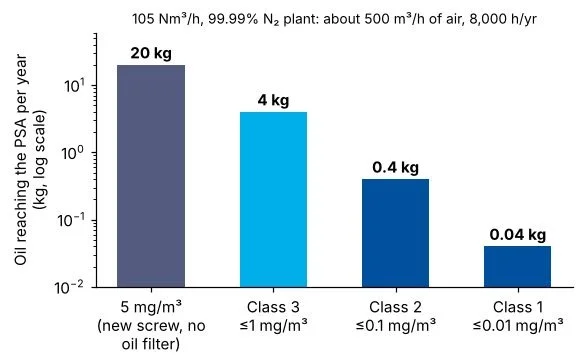
Figure 1: Oil reaching a 105 Nm³/h nitrogen generator in a year at different oil levels
| Oil in the air | Oil reaching the PSA per year |
|---|---|
| 5 mg/m³ (new screw compressor, no oil filtration) | About 20 kg |
| 1 mg/m³ (Class 3) | About 4 kg |
| 0.1 mg/m³ (Class 2) | About 0.4 kg |
| 0.01 mg/m³ (Class 1) | About 0.04 kg |
Table 3: Annual oil load on the example plant (8,000 hours, about 500 m³/h of air)
Twenty kilograms of oil a year is enough to coat a large part of the sieve bed. At Class 1, the same plant sees 40 g a year, which the guard filters and bed can tolerate for a full plant life.
The Filter Train That Gets You There
A typical train from compressor to PSA generator:
- Aftercooler and water separator. Cools the air and removes liquid water, with an automatic drain.
- Air receiver. Settles condensate and smooths pressure; also drained automatically.
- General-purpose coalescing filter (about 1 µm). Removes bulk oil aerosol and particles.
- Refrigerated dryer. Brings the pressure dew point to about +3 °C (Class 4).
- High-efficiency coalescing filter (about 0.01 µm). Removes fine oil aerosol.
- Activated carbon filter or tower. Removes oil vapour, which coalescing filters cannot.
- Dust filter. Catches any carbon fines before the generator.
Every stage needs working drains, pressure-drop indicators and filter elements changed on schedule. A filter that is never changed becomes a bypass. Our post on PSA nitrogen plant problems shows what happens when this slips (6).
Clean Air Also Saves Power
Filters cost pressure. A common rule of thumb is that every 1 bar of extra pressure the compressor must make adds about 7% to its power. In the example above, the calculator puts power at ₹2.89 per Nm³ at ₹8 per kWh, or about ₹24.3 lakh a year over 8,000 hours. A clogged filter train adding 0.5 bar would cost about 3.5%, or roughly ₹85,000 a year, before any damage to the sieve.
So the aim is both: the right air quality, at the lowest pressure drop, with elements changed when the indicator says so.
What This Means for Sieve Life
In a well-designed plant fed with clean, dry air, the molecular sieve lasts the full life of the generator, about 10 years (7). When it does not, replacement typically costs 30–40% of the generator price (7). That is why Absstem offers molecular sieve warranties of up to 10 years (8): the warranty only makes sense when the air treatment is right. High-purity nitrogen is where this matters most (9).
How to Check Your Air
- Pressure dew point: a fixed dew-point sensor after the dryer, with an alarm.
- Pressure drop: across each filter, logged weekly.
- Formal testing: the other parts of ISO 8573 set the test methods for measuring compressed air purity (2). Use them for commissioning and after major changes.
Internal Resources – Next Steps
- PSA Nitrogen Generator: Complete Engineering Guide
- PSA Oxygen Generator: Complete Engineering Guide
- nGEN – PSA Industrial Nitrogen Generator
- Absstem’s Free Proprietary ROI and Savings Calculator
- Inside a PSA Tower: ZMS, CMS, Sieve Layers and Why Towers Fail
- Pressure Swing Adsorption (PSA): How It Works
Consult Us
For PSA oxygen and nitrogen generators sized to your plant, contact us:
- Email: info@absstem.com
- Phone: 1800 547 0506 (toll-free)
- Website: absstem.com
References
- Absstem Technologies. (2026). Inside a PSA Tower: ZMS, CMS, Sieve Layers and Why Towers Fail.
- International Organization for Standardization. (2010). ISO 8573-1:2010 Compressed Air, Part 1: Contaminants and Purity Classes.
- US Patent 7,717,981. Performance Stability in Shallow Beds in Pressure Swing Adsorption Systems.
- Absstem Technologies. (2024). Understanding Molecular Sieves or Adsorbents: CMS & ZMS.
- British Compressed Air Society. An Understanding of ISO 8573: The Compressed Air Quality Standard (BPG 107).
- Absstem Technologies. (2023). PSA Nitrogen Plant Problems and How to Fix Them.
- Absstem Technologies. (2024). How to Choose a PSA Oxygen or Nitrogen Generator.
- Absstem Technologies. (2025). Grade 5 Nitrogen (99.999%): Myths vs Reality.
- Absstem Technologies. (2026). High-Purity PSA Nitrogen (99.999%+): The Engineering Guide.