
Introduction
A PSA oxygen generator is commissioned at 93% and runs well for months. Then the purity display starts to read 91%, then 89%, then 88%. For a hospital, 88% is not a small shortfall. It is outside the specification for Oxygen 93.
Purity rarely falls for a mysterious reason. Absstem Shield maintains PSA plants across India, including plants built by other manufacturers (1), and a purity drop almost always traces back to one of five places: the analyser, the demand, the feed air, the valves or the sieve. This guide gives the order in which to check them, the patterns that point to each one, and a real case from the Shield team.
For how the towers and molecular sieves work inside, see our guide to PSA towers (2).
Why 88% Matters
The US Pharmacopeia defines Oxygen 93 Percent as oxygen made from air by the molecular sieve process, containing not less than 90.0% and not more than 96.0% oxygen by volume, the rest mostly argon and nitrogen (3). The WHO International Pharmacopoeia uses the same 90–96% range, often written as 93 ± 3% (4). For more on purity standards in hospitals, see our posts on medical oxygen (5) and oxygen purity in healthcare (6).
So a plant at 88% has left the specification, even though it is still producing oxygen-rich gas. Commissioning guidance for PSA plants requires purity to stay above 90% at all times, checked with a handheld analyser at the tank outlet and at bedside outlets (7).
There is also a ceiling. Air holds about 20.95% oxygen and 0.93% argon, and zeolite does not separate argon from oxygen. The highest purity a PSA oxygen plant can reach is therefore about 95.7%..
Step 1: Is the Reading Real?
Check the analyser before touching the plant. A drifting sensor sends teams chasing problems that do not exist.
- Check against a second analyser. The Global Fund recommends recording oxygen purity daily with at least two different analysers (8).
- Check calibration. Calibrate as the analyser maker instructs, and check the reading on ambient air (about 20.9%).
- Check the sample line. A leaking or wet sample line, or a sample point downstream of a leak, can read low.
If two analysers agree on 88%, the problem is in the plant.
Step 2: Is the Plant Being Overdrawn?
This is the most common cause, and the easiest to fix. A PSA plant trades purity for flow: draw more gas than it was designed for and purity falls. A Global Fund briefing gives the example of a 20 Nm³/h plant at 93 ± 3% that delivers only 18 Nm³/h when set for 95 ± 1% (4).
Signs of overdraw:
- Purity falls at busy times (ward rounds, cylinder filling, a new production line) and recovers at night.
- Buffer tank pressure drops below its normal band (9).
- The product flow meter reads above the rated flow.
- A new branch, extra cylinder-filling ramp or leak has been added since commissioning.
Fix: find and close leaks, set a flow-control valve at the rated flow, or add capacity. Do not raise the cycle settings to chase flow.
Step 3: Is the Feed Air Right?
The generator can only separate the air it is given. Check four things:
| Check | What goes wrong | Effect on purity |
|---|---|---|
| Compressor pressure and free air delivery | Worn compressor, slipping belt, clogged intake filter, unloading early | Less air per cycle, lower adsorption pressure, purity falls |
| Air temperature at the generator inlet | Aftercooler fouled, hot plant room, dryer bypassed | Adsorption efficiency falls as temperature rises (10) |
| Dew point | Refrigerated dryer fault, failed auto drain, liquid water carry-over | Water is the critical contaminant for zeolite and reduces its nitrogen capacity (11) |
| Oil and dust | Separator failure, filter elements past their life | Coats the sieve, often permanently (2) |
Table 1: Feed-air checks for a PSA oxygen purity drop
Dust deserves special mention in Indian conditions. A root-cause study of PSA plants found that dust speeds up the wear of moving parts, causes overheating and restricts airflow (12).
Step 4: Are the Valves and Cycle Working?
Each tower pressurises, produces, equalises and vents many times an hour. If any step is short or leaking, nitrogen breaks through into the product.
- Uneven purity between towers. Watch the analyser over several cycles. If purity dips every time one particular tower is producing, suspect that tower’s valves or its part of the bed.
- Leaking or sticking valves. Listen for valves that hiss when closed and check pilot air on pneumatic valves.
- Clogged exhaust silencer. A blocked silencer slows depressurisation, so the tower does not regenerate fully and purity falls.
- Timer or controller settings changed. Compare the cycle times with the commissioning record.
Step 5: Is the Sieve Damaged?
Only after Steps 1–4 should the sieve be suspected, because sieve work is the most expensive fix. Signs that point to the sieve:
- Purity has fallen slowly over months and does not recover at low flow.
- The fall followed a dryer failure, a power cut with wet air in the line, or an oil event.
- Dust at the outlet filter, or rising pressure drop across the towers.
- Frequent sieve topping up, which points to bed movement and attrition (2).
Replacing molecular sieve typically costs 30–40% of the price of the generator (13), which is why protecting the sieve with clean, dry air is far cheaper than replacing it.
Quick Diagnosis Table
| Pattern you see | Most likely cause | Go to |
|---|---|---|
| Two analysers disagree | Analyser drift or sample line | Step 1 |
| Purity low at busy times, fine at night | Overdraw or a leak | Step 2 |
| Purity low on hot afternoons | Feed air too hot | Step 3 |
| Purity dropped after a dryer fault or power cut | Moisture in the sieve | Steps 3 and 5 |
| Purity dips every time one tower produces | Valve leak or one bed damaged | Steps 4 and 5 |
| Purity falling slowly for months at any flow | Sieve contamination or attrition | Step 5 |
Table 2: Purity-drop patterns and where to start
Field Case from Absstem Shield
- Site: 300-bed district hospital in Northeast India
- Plant: Absstem 500 LPM plant that’s been running for 6 years
- What the hospital saw: The purity reading had gone down – from 93% to 88% slowly, within two weeks
- What we checked first: We checked the analyser first.
- Root cause: We realized that the Oxygen sensor’s life was over and that the oxygen purity was, in actuality, 93% itself
- Fix: We replaced the oxygen sensor
- Result: As soon as we replaced the sensor, the purity reading was back to being correct – in fact it reached 94%
What a Purity Drop Costs
When a hospital plant goes out of specification, the hospital switches to cylinders. A 50 Nm³/h plant supplies about 1,200 Nm³ a day, which is about 171 standard 7 m³ cylinders. At ₹350 a cylinder, that is about ₹60,000 a day in backup oxygen.
We ran this through the Existing Maintenance vs Absstem Shield calculator in Absstem’s Free Proprietary ROI and Savings Calculator: ₹1.6 lakh a year of maintenance bills and 10 days a year out of specification paid as they come, against a Shield CMC at ₹2.5 lakh a year with 2 days out of specification.
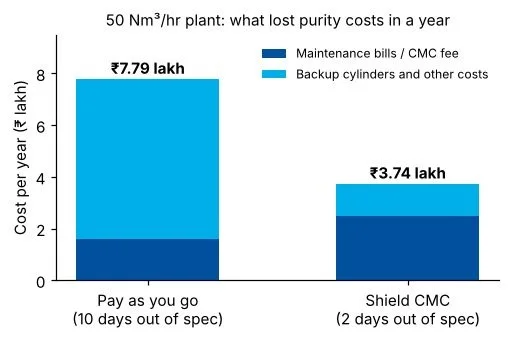
Figure 1: Yearly cost for a 50 Nm³/h plant, paying as you go vs Shield CMC (Absstem’s Free Proprietary ROI and Savings Calculator)
| Parameter | Pay as you go | Shield CMC |
|---|---|---|
| Maintenance or CMC per year | ₹1,60,000 | ₹2,50,000 |
| Days out of specification | 10 | 2 |
| Backup cylinders and other costs | ₹6,18,500 | ₹1,23,700 |
| Total per year | ₹7,78,500 | ₹3,73,700 |
| Saving with CMC | – | ₹4,04,800 a year (₹20,24,000 over 5 years) |
Table 3: Cost of lost purity for a 50 Nm³/h plant (Absstem’s Free Proprietary ROI and Savings Calculator; inputs are illustrations)
At ₹8 per kWh, the calculator puts the power for this plant at ₹7.92 per Nm³, or about ₹9,500 a day of normal running. A day out of specification costs over six times that.
How to Stop It Happening Again
- Log purity, flow, buffer pressure, dew point and inlet temperature every day.
- Check the analyser against a second unit every week.
- Change filter elements and service the dryer on schedule (14).
- Keep demand within the rated flow, and add capacity before adding new users.
- Keep the plant room cool, ventilated and free of dust.
- Use a maintenance contract that includes purity checks, not just breakdown calls. A study of PSA plants found 60% overdue for maintenance at the time of assessment (12). For common misconceptions, see our myths-versus-reality post on PSA maintenance (15).
Internal Resources – Next Steps
- MedO – PSA Medical Oxygen Generator
- Absstem Shield – AMC and CMC for PSA plants
- Absstem’s Free Proprietary ROI and Savings Calculator
Consult Us
For PSA oxygen and nitrogen generators sized to your plant, contact us:
- Email: info@absstem.com
- Phone: 1800 547 0506 (toll-free)
- Website: absstem.com
References
- Absstem Technologies. (2024). Absstem Shield and Maintenance Contracts for Oxygen Generators.
- Absstem Technologies. (2026). Inside a PSA Tower: ZMS, CMS, Sieve Layers and Why Towers Fail.
- United States Pharmacopeia. Oxygen 93 Percent (USP–NF monograph).
- The Global Fund and Build Health International. (2024). Briefing Note: PSA Plant Oxygen Purity.
- Absstem Technologies. (2024). What Is Medical Oxygen? Purity and Standards.
- Absstem Technologies. (2024). Importance of Oxygen Purity in Healthcare Applications.
- The Global Fund and Build Health International. (2024). PSA Oxygen Plant Commissioning Guidelines.
- The Global Fund. PSA Oxygen Plant Sustainability: Overview.
- Absstem Technologies. (2024). The Importance of Storage Tank Volume in PSA Systems.
- Canadian Patent 1,069,062. Air Separation by Adsorption.
- US Patent 7,717,981. Performance Stability in Shallow Beds in Pressure Swing Adsorption Systems.
- PATH. Root Cause Analysis of PSA Plant Disrepair.
- Absstem Technologies. (2024). How to Choose a PSA Oxygen or Nitrogen Generator.
- Absstem Technologies. (2025). PSA Oxygen Plant Maintenance: Schedule, Checks and Repairs.
- Absstem Technologies. (2025). PSA Oxygen Plant Repair and Maintenance: Myths vs Reality.