
Introduction
High-purity nitrogen, 99.999% (Grade 5, N5.0) and above, is where PSA nitrogen generation becomes real engineering. At 95% or 99.9%, almost any PSA generator will do the job. At 99.999%, the generator must keep oxygen below 10 parts per million, every hour of every day, while using as little compressed air as possible. Small design differences show up as large differences in the power bill and in how reliably the purity is maintained.
This guide explains what 99.999% really means, how a PSA generator reaches it without hydrogen or ammonia, what it costs in energy, which design and installation details decide whether a high-purity plant performs, and how direct PSA compares with PSA plus Deoxo.
Note
High-purity nitrogen is Absstem’s core specialisation. Absstem PSA nitrogen generators produce up to 99.9995% nitrogen directly from compressed air (1).
What 99.999% Nitrogen Actually Means
Nitrogen purity is defined by the oxygen left in the gas, because oxygen is the contaminant that matters in almost every nitrogen application (1). Argon from the air travels with the nitrogen, but argon is inert, so it does not count against purity for these uses.
| Purity | Grade | Maximum oxygen | Typical uses |
|---|---|---|---|
| 99.99% | N4.0 | 100 ppm | Tyre manufacturing, welding, pharmaceutical processes, cable curing |
| 99.995% | N4.5 | 50 ppm | Heat treatment, electronics manufacturing |
| 99.999% | N5.0 | 10 ppm | Laser cutting with oxide-free edges, heat treatment, electronics manufacturing |
| 99.9995% | N5.5 | 5 ppm | The highest purities produced directly by PSA |
Table 1: High-purity nitrogen grades, oxygen limits and typical applications(2)(3)
Going from 99.99% to 99.999% looks like a small step, but it cuts the permitted oxygen tenfold, from 100 ppm to 10 ppm.
How a PSA Generator Reaches 99.999%
A PSA nitrogen generator uses two towers filled with carbon molecular sieve (CMS). Compressed air passes through one tower. Oxygen molecules are slightly smaller than nitrogen molecules (kinetic diameter about 0.346 nm against 0.364 nm), so they enter the pores of the CMS faster and are held back, while nitrogen passes through as product gas (4). Before the sieve is saturated, the towers swap: the loaded tower is depressurised to release its oxygen, and the fresh tower takes over.
To push purity from 99.9% to 99.999%, the generator must stop each production step earlier, before even a trace of oxygen breaks through. That means each tonne of sieve produces less nitrogen per cycle, and more compressed air is needed for each Nm³ of product. This is the physical reason high purity costs more energy.
No hydrogen, no ammonia
The older way to make Grade 5 nitrogen was to run the PSA at 99.5–99.9% and remove the remaining oxygen in a Deoxo unit, where hydrogen reacts with oxygen over a palladium catalyst to form water. Because hydrogen is expensive, cracked ammonia was often used as the hydrogen source. Modern PSA generators can produce up to 99.9995% directly from compressed air, without hydrogen or ammonia, which removes both a running cost and a safety hazard (1).
The Energy Cost of Purity
Almost all the electricity a PSA nitrogen generator uses goes into the air compressor, so energy per Nm³ tracks the amount of air needed per Nm³ of nitrogen (5).
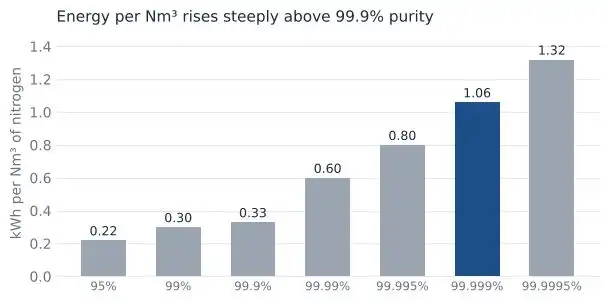
Figure 1: Energy per Nm³ of PSA nitrogen at each purity (Absstem data)
| Purity | Energy (kWh/Nm³) | Cost per Nm³ at ₹8/kWh | Compared with 99.9% |
|---|---|---|---|
| 99.9% | 0.33 | ₹2.64 | 1.0× |
| 99.99% | 0.60 | ₹4.80 | 1.8× |
| 99.995% | 0.80 | ₹6.40 | 2.4× |
| 99.999% | 1.06 | ₹8.48 | 3.2× |
| 99.9995% | 1.32 | ₹10.56 | 4.0× |
Table 2: Energy and power cost of high-purity PSA nitrogen (Absstem data, ₹8 per kWh) (1)(5)
Two lessons follow. First, specify the purity the process really needs, because every extra nine is expensive. Second, at high purity the efficiency of the generator matters far more than at low purity: a design that needs 10% more air per Nm³ costs 10% more on every unit of nitrogen for the life of the plant.
Engineering Details That Decide High-Purity Performance
1. Compressed air quality
Carbon molecular sieve is permanently damaged by oil and liquid water (4). A high-purity plant therefore needs clean, dry, oil-free air at the inlet: a correctly sized refrigerated dryer, coalescing filters, and an activated carbon filter to remove oil vapour. Filter elements and dryer performance should be checked as part of routine maintenance, because one contamination event can cost the sieve.
2. Air temperature and pressure
The sieve’s ability to separate oxygen and nitrogen depends on temperature and pressure. Hot inlet air, an undersized aftercooler or a compressor delivering less than design pressure all reduce output at high purity. Check the design inlet temperature against your summer conditions, not just the nameplate.
3. Sieve packing and bed design
A well-designed, well-packed sieve bed lasts the life of the plant and rarely needs topping up. Poor packing or high gas velocity lets the sieve granules move, rub and break into dust, which lowers purity and capacity over time (1)(4). Absstem offers molecular sieve warranties of up to 10 years (1).
4. Purity measurement
At 10 ppm you cannot manage what you do not measure. A high-purity plant needs a continuous trace-oxygen analyser with a range suited to ppm levels, and an automatic valve that vents off-specification gas instead of sending it to the process.
5. Start-up time
Older high-purity PSA plants could take one to two hours to reach purity. Modern plants reach purity in about 5–10 minutes, depending on the manufacturer, which saves energy and suits plants that do not run 24 hours a day (1).
6. Buffer storage and turndown
A product buffer tank smooths demand peaks so the generator does not have to chase them at the expense of purity. If your demand varies through the day, ask for a power-saving (turndown) mode that reduces compressor load when demand drops (6).
Direct PSA or PSA + Deoxo?
| Parameter | Direct high-purity PSA | PSA + Deoxo |
|---|---|---|
| How oxygen is removed | Entirely by the PSA sieve | PSA to about 99.5–99.9%, then catalytic reaction with hydrogen |
| Hydrogen or ammonia needed | No | Yes |
| Extra equipment | None | Catalyst vessel, hydrogen supply, dryer for the water formed |
| Safety | No flammable gas | Hydrogen handling and controls required |
| Best fit | Most Grade 5 applications | Very large flows where hydrogen is cheap and already on site |
Table 3: Direct high-purity PSA vs PSA with Deoxo (1)
For most plants that need Grade 5 nitrogen, direct PSA is simpler, safer and cheaper to run. Our PSA vs PSA + Deoxo calculator compares the two for your flow and gas prices (7).
Five Myths About Grade 5 Nitrogen
- “Only liquid nitrogen can deliver 99.999%.” Myth. Modern PSA generators produce consistent 99.999% on site (1).
- “You need hydrogen or ammonia to reach 99.999% with PSA.” Myth, for modern generators (1).
- “Liquid nitrogen is cheaper than high-purity PSA nitrogen.” Myth. PSA nitrogen at 99.999% costs about ₹8.48 per Nm³ in power at ₹8/kWh, against roughly ₹13–25 per Nm³ for liquid nitrogen (1)(8).
- “99.999% is better for every application.” Myth. It costs about 3.2 times as much as 99.9% to produce, and many applications do not need it (1).
- “High-purity PSA plants take hours to start.” Myth for modern plants, which start in about 5–10 minutes (1).
Checklist Before You Buy a High-Purity Generator
- Ask for the guaranteed flow at your purity, not at 99% or 99.9%.
- Ask for the compressor kW and the specific energy (kWh/Nm³) at that purity, in writing.
- Confirm the air treatment package: dryer, coalescing filters and activated carbon filter.
- Check the design inlet air temperature against your site’s summer conditions.
- Ask for the trace-oxygen analyser range and the off-spec vent arrangement.
- Ask for the molecular sieve warranty period and what it covers.
- Ask for the start-up time to reach your purity.
Internal Resources – Next Steps
- nGEN – PSA Industrial Nitrogen Generator
- Myth vs Reality: Grade 5 Nitrogen
- Nitrogen Purity Grades Explained: N2.0 to N6.0
- Free ROI Calculators, including PSA vs PSA + Deoxo
Consult Us
For PSA oxygen and nitrogen generators sized to your plant, contact us:
- Email: info@absstem.com
- Phone: 1800 547 0506 (toll-free)
- Website: absstem.com
References
- Absstem Technologies. (2025). Myth vs Reality: Grade 5 Nitrogen.
- Absstem Technologies. (2024). Understanding Nitrogen Purity in PSA Nitrogen Generators.
- Absstem Technologies. (2026). Nitrogen Purity Grades Explained: N2.0 to N6.0 and What Each Is Used For.
- Absstem Technologies. (2024). Understanding Molecular Sieves or Adsorbents: CMS & ZMS.
- Absstem Technologies. (2024). How to Choose a Good PSA Oxygen or Nitrogen Generator.
- Absstem Technologies. (2026). PSA vs PSA + Deoxo ROI Calculator.
- Absstem Technologies. (2025). Comparison of the Cost of Nitrogen Gas from Different Sources.
- Absstem Technologies. (2025). Comparison of the Cost of Nitrogen Gas from Different Sources.