
Introduction
From the outside, every PSA oxygen or nitrogen generator looks much the same: two tall towers, a panel of valves and a control cabinet. The difference between a plant that holds purity for ten years and one that needs a sieve change in three is almost entirely inside the towers: which adsorbent is used, how the layers are built, how firmly the bed is held, and how well it is protected from oil and water.
This article opens up a PSA tower, explains what each layer does, and lists the real reasons towers fail, with the checks that prevent each one.
What Happens Inside the Towers
Pressure Swing Adsorption separates gases using solid adsorbents, also called molecular sieves. At high pressure, the sieve holds one component of the air on its surface; when the pressure drops, it releases it again (1). Two towers take turns: one produces gas under pressure while the other is depressurised to regenerate. The cycle repeats every minute or so for the plant’s life, so the sieve sees millions of pressure swings.
The Two Sieves: CMS and ZMS
| Parameter | Carbon molecular sieve (CMS) | Zeolite molecular sieve (ZMS) |
|---|---|---|
| Used in | PSA nitrogen generators | PSA oxygen generators |
| What it holds back | Oxygen | Nitrogen |
| How it separates | By speed: oxygen molecules (kinetic diameter about 0.346 nm) enter the pores faster than nitrogen (about 0.364 nm) (1) | By attraction: the zeolite crystal attracts nitrogen more strongly than oxygen (1) |
| Material | Specially activated carbon with tailored pore sizes (1) | Crystalline aluminosilicate, typically with sodium or lithium (some grades silver) (1) |
| Product | Nitrogen, 95% to 99.9995% | Oxygen, typically about 93% |
| Main enemies | Oil, liquid water, attrition | Moisture, oil, attrition |
Table 1: Carbon vs zeolite molecular sieves
The CMS separation depends on a tiny difference in molecular size, which is why the quality of the sieve and the cycle design matter so much for high-purity nitrogen (2).
The Layers Inside a Tower
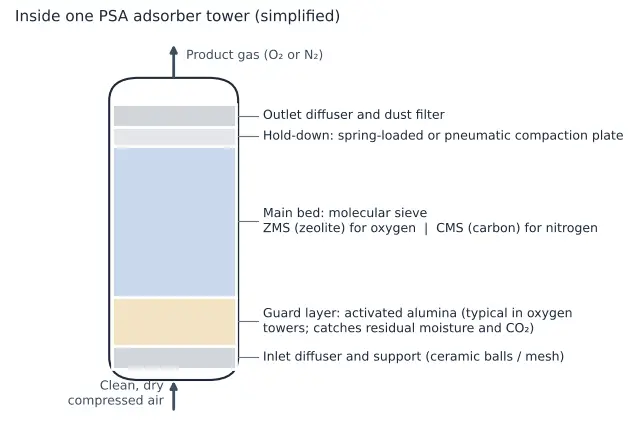
Figure 1: Simplified cross-section of a PSA adsorber tower
| Layer (bottom to top) | What it does |
|---|---|
| Inlet diffuser and support | Spreads the incoming air evenly across the tower and supports the bed, so gas does not jet up one side |
| Guard layer (activated alumina) | In oxygen towers, catches residual moisture and CO₂ before they reach the zeolite, which they would otherwise occupy |
| Main molecular sieve bed | ZMS or CMS: does the actual separation |
| Hold-down (compaction) system | Keeps the bed tightly packed as it settles, so granules cannot move and rub |
| Outlet diffuser and filter | Spreads the flow at the top and stops any dust leaving with the product gas |
Table 2: The layers inside a PSA tower and their jobs
Why PSA Towers Fail
Almost every tower failure falls into one of five causes.
1. Oil contamination
Oil carried over from the compressor coats the sieve and blocks its pores. The damage is usually permanent (1).
Prevention: coalescing filters and an activated carbon filter before the PSA, filter elements changed on schedule, and a compressor in good condition.
2. Moisture
Liquid water and high humidity damage CMS and occupy the sites on ZMS that should hold nitrogen, so purity and capacity fall (1).
Prevention: a correctly sized dryer, automatic drains, a guard layer in oxygen towers, and dew point monitoring.
3. Attrition and dusting
If granules can move, every pressure swing rubs them against each other. Over millions of cycles they break down into powder (1). Dust then raises pressure drop, wears valves and escapes into the product line, while the bed loses volume and purity drops.
Prevention: dense, even filling of the sieve, an effective hold-down system that keeps the bed compacted, and gas velocities kept within design limits, especially during depressurisation.
4. Channelling
When flow is uneven, gas takes the easy path through part of the bed and breaks through before the rest of the sieve is used. Purity drops even though most of the sieve is still good.
Prevention: proper inlet and outlet diffusers, a level, well-compacted bed, and no voids left by settling.
5. Running beyond design
Pushing a generator for more flow, more purity or higher inlet temperature than it was designed for shortens each production step and stresses the bed.
Prevention: size the plant for peak demand and summer temperature, and use buffer storage for short peaks.
| Symptom | Likely cause | First check |
|---|---|---|
| Purity slowly falling over months | Contamination or attrition | Filter condition, oil carry-over, dust at outlet filter |
| Purity drops after a compressor or dryer fault | Oil or moisture event | Dryer dew point, drain function, carbon filter |
| Rising pressure drop across towers | Dust or broken sieve | Outlet filter, valve wear |
| Purity good at low flow, poor at full flow | Channelling or undersized bed | Bed level, hold-down system, flow vs design |
| Purity poor only in summer | Inlet air too hot | Aftercooler, room ventilation |
Table 3: Common PSA purity problems and where to look first
What a Sieve Failure Costs
In a well-designed plant, the molecular sieve lasts the full 10-year life of the generator. When it does not, replacement typically costs 30–40% of the price of the generator (3). That is why the sieve warranty is one of the most important lines in any PSA quote. Absstem offers molecular sieve warranties of up to 10 years (2).
Internal Resources – Next Steps
Consult Us
For PSA oxygen and nitrogen generators sized to your plant, contact us:
- Email: info@absstem.com
- Phone: 1800 547 0506 (toll-free)
- Website: absstem.com
References
- Absstem Technologies. (2024). Understanding Molecular Sieves or Adsorbents: CMS & ZMS.
- Absstem Technologies. (2025). Myth vs Reality: Grade 5 Nitrogen.
- Absstem Technologies. (2024). How to Choose a Good PSA Oxygen or Nitrogen Generator.