
Introduction
The first question every plant owner asks about an on-site oxygen plant is “how much does it cost?” The honest answer has three parts, and most quotes only show you the first one:
- Capital cost: what you pay once for the plant and its installation.
- Running cost: what you pay every month, almost all of it electricity for the air compressor.
- Maintenance cost: what you pay every year to keep the plant at rated flow and purity.
Over a 10-year life, the running cost is usually several times the purchase price. A plant that is cheaper to buy but draws more power can end up costing crores more. This guide explains each part of the cost of an industrial PSA (Pressure Swing Adsorption) oxygen plant in India, shows the running cost for capacities from 10 to 500 Nm³/hr, and shows how to work out your own payback with the free Absstem ROI calculator.
Note
This guide covers industrial oxygen plants (steel, glass, pulp and paper, wastewater, aquaculture, ozone, cutting and brazing). For hospital plants, see our separate guide, What is Medical Oxygen Plant Setup Cost in India (1).
What Is an Industrial PSA Oxygen Plant?
A PSA oxygen plant makes oxygen on site from atmospheric air. An air compressor pushes air through towers filled with zeolite molecular sieve. The sieve holds back nitrogen, and oxygen passes through at a typical purity of 90-95%. The towers take turns: one adsorbs while the other releases the trapped nitrogen, so the oxygen flow is continuous. There is no liquid, no cylinders and no delivery truck. The only raw material is air, and the main input is electricity.
A complete plant usually includes:
- Air compressor (the largest single power consumer)
- Refrigerated air dryer and filters (to remove moisture and oil before the sieve)
- Air receiver tank
- PSA towers with zeolite molecular sieve, valves and controller
- Oxygen buffer tank and oxygen analyser
- Outlet piping to your point of use
Capital Cost: What You Pay Once
The capital cost of a PSA oxygen or nitrogen plant in India ranges from about ₹5 lakh for a small plant to about ₹10 crore for a large one (2). Where your plant falls in that range depends on a handful of specifications:
| Cost driver | Why it changes the price |
|---|---|
| Capacity (Nm³/hr) | More flow needs larger towers, more sieve, a bigger compressor and a dryer |
| Purity | Higher purity needs more air per Nm³ of oxygen, so a bigger compressor |
| Outlet pressure | Standard plants deliver at low pressure; processes that need higher pressure need an extra oxygen booster |
| Duty and redundancy | Standby compressors or twin trains for 24×7 critical processes add cost |
| Cylinder filling | A booster compressor, filling manifold and PESO-compliant filling area add cost (and paperwork) |
| Site conditions | High ambient temperature, dust, humidity or altitude can require larger dryers, filters or compressors |
| Monitoring | Remote (IIoT) monitoring, data logging and alarms |
Table 1: What drives the capital cost of an industrial PSA oxygen plant
Installation scope: what to check in every quote
Two quotes for the “same” plant can differ because one includes items the other leaves out. Before comparing prices, check whether each quote includes:
- Air compressor, dryer, filters and air receiver (some quotes show the PSA skid only)
- Oxygen buffer tank and online oxygen analyser
- Interconnecting piping, valves and electrical cabling
- Civil foundation and plant room ventilation
- Transport, unloading, erection and commissioning
- Booster compressor and filling manifold, if you will fill cylinders. Cylinder filling also needs PESO notification; see our PESO guide (3)
- Operator training, documentation and the warranty on the molecular sieve
Running Cost: The Cost That Really Matters
The running cost of a PSA oxygen plant is almost entirely the electricity used to compress air (2). An Absstem PSA oxygen plant uses about 1.1 kWh of electricity per Nm³ of oxygen (4). At a power tariff of ₹8 per kWh, that is:
1.1 kWh × ₹8 = ₹8.80 per Nm³ of oxygen
Because the cost scales directly with your tariff, here is the cost per Nm³ at common industrial tariffs:
| Power tariff (₹/kWh) | 6 | 7 | 8 | 9 | 10 |
|---|---|---|---|---|---|
| PSA oxygen cost (₹/Nm³) | 6.60 | 7.70 | 8.80 | 9.90 | 11.00 |
Table 2: PSA oxygen running cost per Nm³ at different power tariffs (1.1 kWh/Nm³)
Running cost by capacity
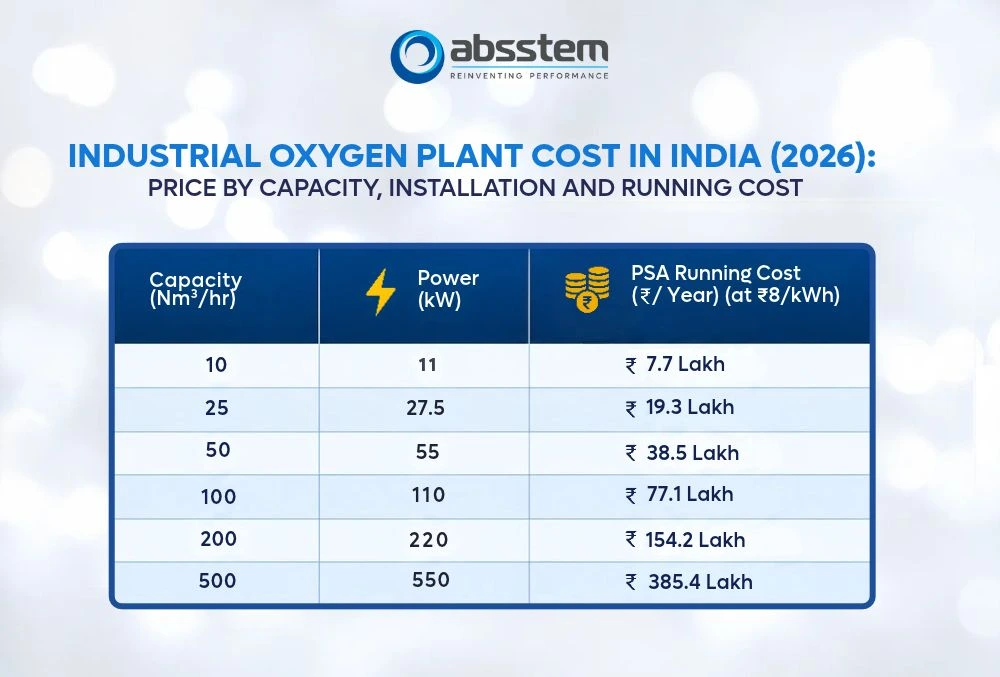
The table below shows the electricity cost of running a PSA oxygen plant 24 hours a day at ₹8 per kWh, for common industrial capacities, alongside what the same oxygen would cost from liquid oxygen (₹15–25 per Nm³) or high-pressure cylinders (₹30–60 per Nm³) (4).
| Capacity (Nm³/hr) | Power drawn (kW) | PSA running cost per month (₹) | PSA running cost per year (₹ lakh) | Same oxygen as liquid, per year (₹ lakh) | Same oxygen from cylinders, per year (₹ lakh) |
|---|---|---|---|---|---|
| 10 | 11 | 63,360 | 7.7 | 13.1 – 21.9 | 26.3 – 52.6 |
| 25 | 27.5 | 1,58,400 | 19.3 | 32.9 – 54.8 | 65.7 – 131.4 |
| 50 | 55 | 3,16,800 | 38.5 | 65.7 – 109.5 | 131.4 – 262.8 |
| 100 | 110 | 6,33,600 | 77.1 | 131.4 – 219.0 | 262.8 – 525.6 |
| 200 | 220 | 12,67,200 | 154.2 | 262.8 – 438.0 | 525.6 – 1,051.2 |
| 500 | 550 | 31,68,000 | 385.4 | 657.0 – 1,095.0 | 1,314.0 – 2,628.0 |
Table 3: PSA oxygen running cost by capacity vs liquid and cylinder supply (24 hrs/day, 30 days/month, ₹8/kWh)
Two things stand out. First, at every capacity the PSA plant’s yearly running cost is lower than the yearly cost of buying the same oxygen from cylinders or liquid . Second, the yearly difference is usually larger than the price of the plant, which is why on-site oxygen plants commonly pay back in months rather than years.
Maintenance Cost
A PSA plant needs regular maintenance: filter changes, compressor servicing, valve checks, analyser calibration and, eventually, sieve care. The simplest way to budget for it is a Comprehensive Maintenance Contract (CMC), which typically costs 7–10% of the plant cost per year (2). It is small next to the running cost, but skipping it is expensive: a neglected plant loses purity and flow, and the cost of emergency cylinders during a breakdown quickly exceeds the CMC fee. Absstem Shield covers AMC and CMC for PSA plants (5).
Why the Cheapest Plant Is Often the Most Expensive
Our analysis of two vendor quotes for the same duty shows how this works (2). Both plants were quoted for 50 Nm³/hr of nitrogen at 95 % purity. Vendor 1 was cheaper to buy but needed a 75 kW compressor; Vendor 2 cost ₹10 lakh more but needed only 55 kW.
| Vendor 1 | Vendor 2 | |
|---|---|---|
| Plant cost | ₹20,00,000 | ₹30,00,000 |
| Compressor power | 75 kW | 55 kW |
| Operating cost per year | ₹52,56,000 | ₹38,54,400 |
| Maintenance in 10 years (10% per year) | ₹20,00,000 | ₹30,00,000 |
| Total 10-year lifecycle cost | ₹5,65,60,000 | ₹4,45,44,000 |
| Savings with Vendor 2 | – | ₹1,20,16,000 |
Table 4: Lifecycle cost of two PSA plant quotes for the same duty (Absstem analysis, ₹8/kWh, 24 hrs/day)
Spending ₹10 lakh more up front saved ₹1.2 crore over ten years: twelve times the price difference. When you compare quotes, ask every supplier for the compressor kW and the guaranteed flow at your purity in writing, then compare the power bill, not just the price. Absstem’s PSA vs Any PSA calculator does this comparison for you (6).
Worked Example: Payback for a 100 Nm³/hr Plant
We ran a typical case through the free Absstem ROI calculator (PSA vs Liquid): a plant using 100 Nm³/hr of oxygen around the clock, currently buying liquid oxygen at ₹20 per Nm³ with a tank rental of ₹50,000 a month, and a power tariff of ₹8 per kWh.
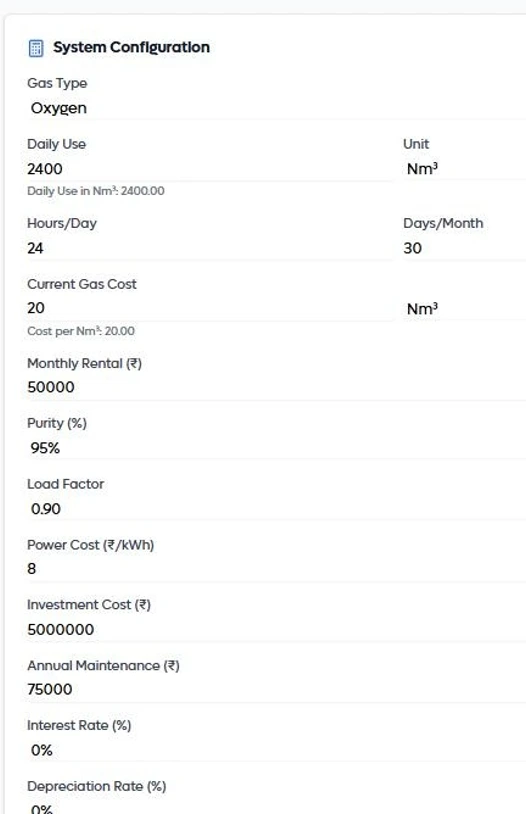
Figure 1: PSA vs Liquid calculator inputs for 100 Nm³/hr of oxygen (2,400 Nm³ a day) at ₹20 per Nm³
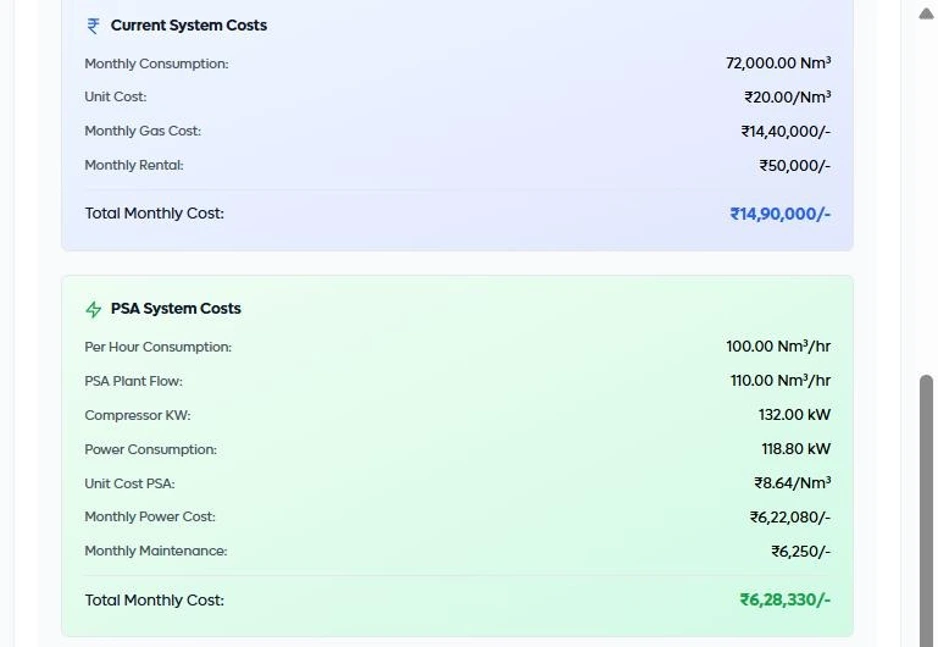
Figure 2: Calculator result: current liquid supply ₹14,90,000 a month vs PSA running cost ₹6,28,330 a month
| Item | Liquid oxygen | PSA oxygen plant |
|---|---|---|
| Oxygen per month | 72,000 Nm³ | 72,000 Nm³ |
| Cost per Nm³ | ₹20.00 | ₹8.64 |
| Gas/power cost per month | ₹14,40,000 | ₹6,22,080 |
| Rental/maintenance per month | ₹50,000 | ₹6,250 |
| Total per month | ₹14,90,000 | ₹6,28,330 |
| Saving per month | – | ₹8,61,670 |
Table 5: Monthly cost of 100 Nm³/hr of oxygen – liquid supply vs PSA (Absstem ROI calculator)
With a monthly saving of about ₹8.6 lakh, the payback period is simply your plant price divided by that saving:
| If your installed plant cost is | ₹25 lakh | ₹50 lakh | ₹75 lakh | ₹1 crore | ₹1.5 crore |
|---|---|---|---|---|---|
| Payback period | 2.9 months | 5.8 months | 8.7 months | 11.6 months | 17.4 months |
Table 6: Payback period at different plant prices, for the 100 Nm³/hr example above
The plant prices in Table 6 are illustrations, not quotes. Put your own quote, gas price and tariff into the calculator to get your real figure (6).
How to Get an Accurate Price for Your Plant
To give you a firm price, any manufacturer will need:
- Required oxygen flow (Nm³/hr) and how it varies across the day
- Required purity and delivery pressure at the point of use
- Whether you need to fill cylinders
- Site conditions: ambient temperature, altitude, space and available power
- Your current oxygen bills (to calculate payback)
Internal Resources – Next Steps
- Idos – PSA Industrial Oxygen Generator
- Idos C – Affordable PSA Industrial Oxygen Generator for SMEs
- Free ROI Calculators – PSA vs Liquid, PSA vs Cylinders, PSA vs Any PSA
- Absstem Shield – AMC and CMC for PSA plants
Consult Us
For PSA oxygen and nitrogen generators sized to your plant, contact us:
- Email: info@absstem.com
- Phone: 1800 547 0506 (toll-free)
- Website: absstem.com
References
- Absstem Technologies. (2025). What is Medical Oxygen Plant Setup Cost in India.
- Absstem Technologies. (2025). Operational Cost Versus Capital Cost of a PSA Oxygen or Nitrogen Plant.
- Absstem Technologies. (2026). PESO Licence for Oxygen Cylinder Filling Station in India – What You Actually Need.
- Absstem Technologies. (2025). Comparison of the Cost of Oxygen Gas from Different Sources.
- Absstem Technologies. (2026). ROI Calculators for Oxygen and Nitrogen (PSA vs Liquid, PSA vs Cylinders, PSA vs Any PSA).