
Introduction
Hospitals, workshops and factories use oxygen cylinders every day, yet one simple question causes a lot of confusion: how much oxygen is actually in a cylinder? The answer matters, because it tells you how many cylinders you need each day, how many hours one cylinder will last, and what you are really paying for every cubic metre of oxygen.
This guide explains in plain language how to work out the gas in a cylinder, how much the common cylinder sizes hold, and how much cheaper an on-site PSA oxygen plant is compared with cylinders.
Note
This article is the English edition of our Hindi guide, ऑक्सीजन सिलेंडर में कितनी गैस होती है . For the full technical method, see Calculation of Volume of Gas Stored in a High-Pressure Cylinder (1).
What Decides How Much Gas a Cylinder Holds?
- Water capacity: how many litres of water the cylinder would hold if filled completely. This is the true internal volume of the cylinder and is stamped on its shoulder.
- Pressure: how hard the gas has been pushed into the cylinder. In India, most oxygen cylinders are filled to about 150 bar (about 150 kg/cm²).
The Simple Formula
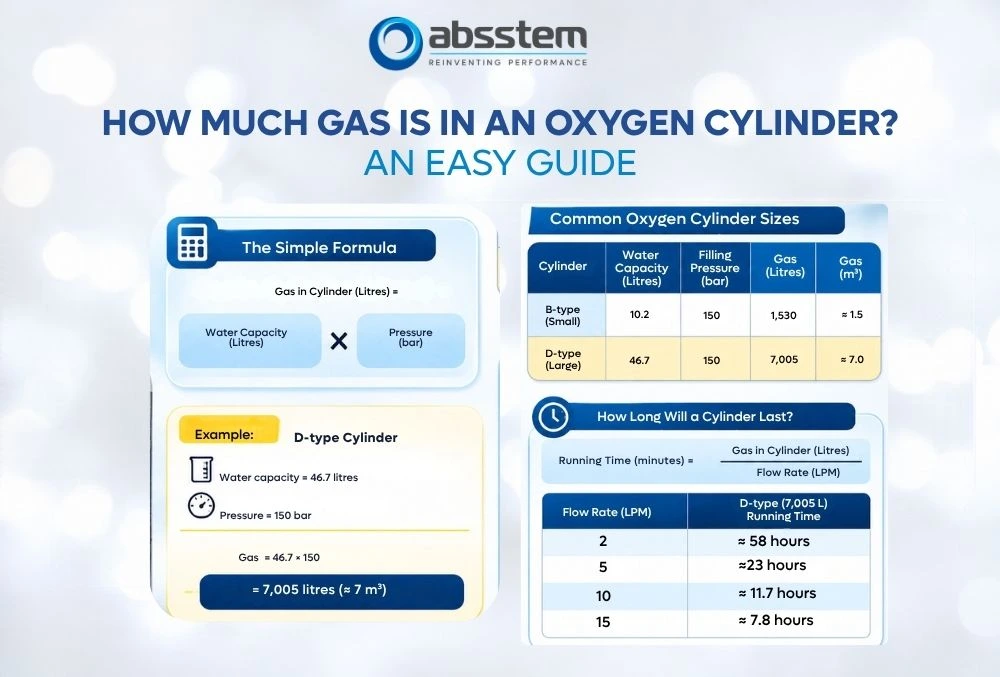
Gas in the cylinder (litres) = Water capacity (litres) × Pressure (bar)
In other words, the bigger the cylinder and the higher the pressure, the more gas it holds. The formula is accurate enough for everyday use; at very high pressures, the real amount can differ slightly (1).
Example: D-type cylinder
A D-type cylinder has a water capacity of46.7 litresand is filled to150 bar:
46.7 litres × 150 bar = 7,005 litres of oxygen ≈ 7 m³ (cubic metres)
That is why the D-type is commonly called a “7 cubic metre cylinder” in the market (1).
Common Cylinder Sizes and the Gas They Hold
| Cylinder | Water capacity (litres) | Filling pressure (bar) | Gas (litres) | Gas (m³) |
|---|---|---|---|---|
| B-type (small) | 10.2 | 150 | 1,530 | 1.5 |
| D-type (large) | 46.7 | 150 | 7,005 | 7.0 |
Table 1: Common oxygen cylinder sizes and the gas they hold
How Much Gas Is Left as the Pressure Drops?
The pressure gauge tells you how much gas is left inside. The lower the pressure, the less gas remains. For a D-type (46.7-litre) cylinder (1):
| Pressure (bar) | Gas (litres) | Gas (m³) |
|---|---|---|
| 150 | 7,005 | 7.0 |
| 140 | 6,538 | 6.5 |
| 130 | 6,071 | 6.1 |
| 120 | 5,604 | 5.6 |
| 110 | 5,137 | 5.1 |
| 100 | 4,670 | 4.7 |
Table 2: Gas in a D-type cylinder at different pressures
Watch out: if a cylinder from your supplier is filled to 130 bar instead of 150, you are getting about 1 m³ (roughly 13%) less gas while paying for a full cylinder. Always check the gauge when cylinders are delivered.
Usable Gas: What You Actually Get
Cylinders are never emptied completely. A little pressure is left inside so the regulator keeps working and moisture or dirt cannot get in. For example, if a D-type cylinder is returned at 10 bar:
Gas used = 46.7 × (150 − 10) = 6,538 litres | Gas returned = 46.7 × 10 = 467 litres (about 7%)
So every cylinder goes back with some gas you have already paid for but never used.
How Long Will a Cylinder Last?
How long a cylinder lasts depends on the flow rate:
Running time (minutes) = Gas in the cylinder (litres) ÷ Flow rate (litres per minute)
| Flow rate (LPM) | D-type cylinder (7,005 litres) | B-type cylinder (1,530 litres) |
|---|---|---|
| 2 | About 58 hours | About 12.7 hours |
| 5 | About 23 hours | About 5.1 hours |
| 10 | About 11.7 hours | About 2.6 hours |
| 15 | About 7.8 hours | About 1.7 hours |
Table 3: Approximate running time of a full cylinder (150 bar) until completely empty
In practice cylinders are not run completely empty, so the real running time will be a little shorter.
What Does Cylinder Oxygen Really Cost?
A D-type cylinder holds about 7 m³ of oxygen, so divide the cylinder price by 7 to get the cost per m³. In India, cylinder oxygen typically costs ₹30 to ₹60 per m³, while the same oxygen from an on-site PSA oxygen plant costs about ₹8.80 per m³ (with power at ₹8 per unit) (2).
Example: 20 cylinders a day
We entered this case into Absstem’s free ROI calculator (PSA vs Cylinders): 20 D-type cylinders a day at ₹350 per cylinder, 24 hours a day, 30 days a month.
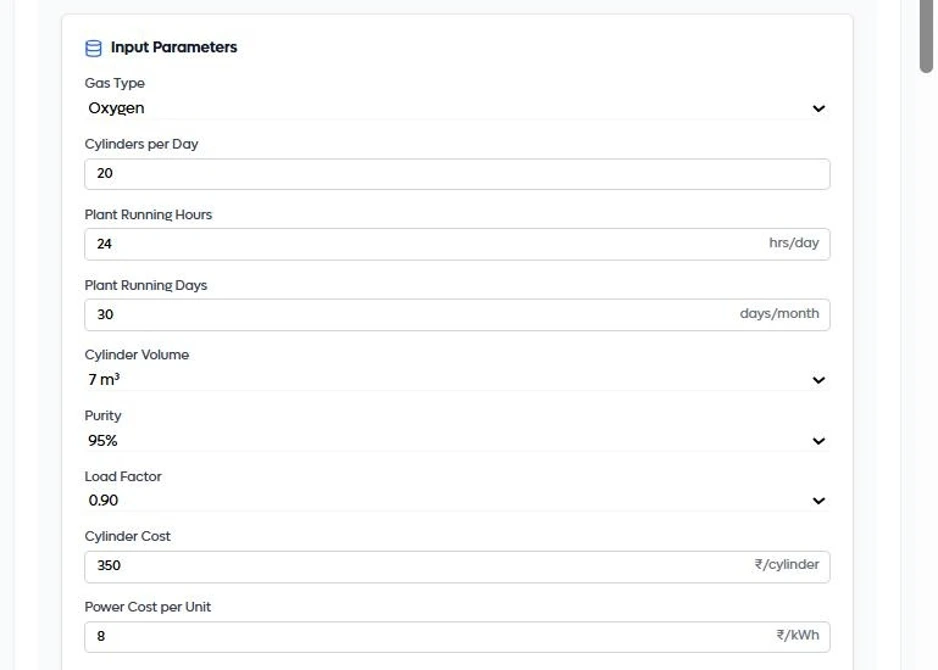
Figure 1: PSA vs Cylinders calculator: oxygen, 20 cylinders a day, 7 m³, ₹350 per cylinder
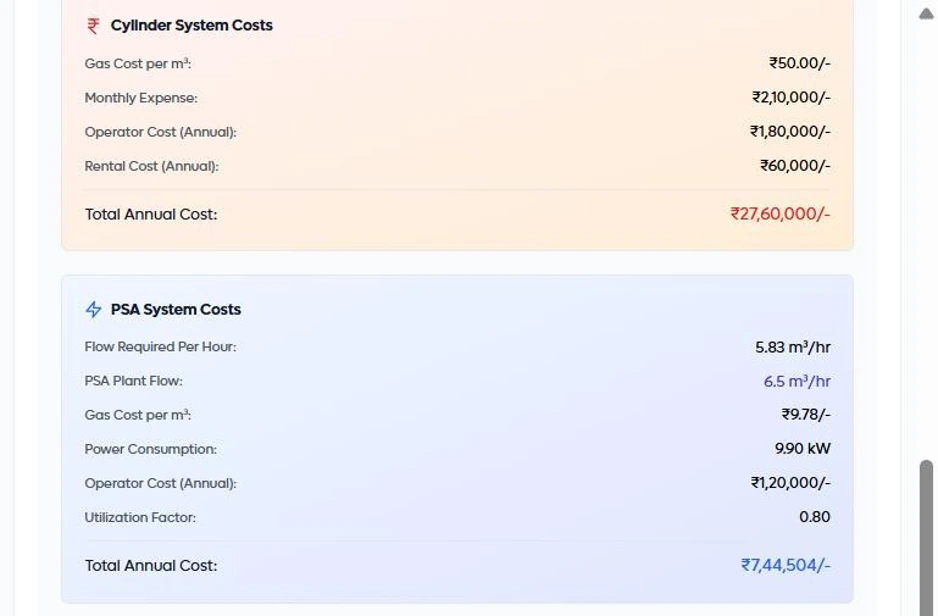
Figure 2: Calculator result: cylinders cost ₹50 per m³ and ₹27.6 lakh a year; a PSA plant costs about ₹9.78 per m³ and ₹7.4 lakh a year
| Parameter | Cylinders | PSA oxygen plant |
|---|---|---|
| Oxygen per day | 20 × 7 = 140 m³ | 140 m³ (about 5.8 m³ per hour) |
| Cost per m³ | ₹350 ÷ 7 = ₹50 | About ₹9.78 |
| Total cost per year (calculator) | ₹27,60,000 | ₹7,44,504 |
Table 4: 20 cylinders a day – cylinders vs PSA oxygen plant (Absstem ROI calculator; cylinder cost includes operator and rental)
In this example, a PSA plant saves about ₹20 lakh every year. Enter your own figures to work out your savings at absstem.com/calculators/ (3).
When Are Cylinders Fine, and When Is a PSA Plant Better?
- Cylinders are fine for: very low or occasional use, ambulances and patient transfers, and as a backup supply.
- A PSA plant is better for: continuous daily oxygen demand, such as hospitals, steel, glass, welding and cutting, or fish farming. Cylinder transport, returning empties and the fear of running short all disappear.
- Cylinder filling business: if you want to fill cylinders from a PSA plant, you must notify PESO. See our PESO guide (4).
Essential Safety Tips
- Always store cylinders upright and chained.
- Never put oil or grease on an oxygen cylinder, valve or regulator – it can cause a fire.
- Check the hydro-test date on the cylinder; do not accept expired cylinders (4).
- Keep cylinders away from sunlight and heat.
Internal Resources – Next Steps
Consult Us
For PSA oxygen and nitrogen generators sized to your plant, contact us:
- Email: info@absstem.com
- Phone: 1800 547 0506 (toll-free)
- Website: absstem.com
References
-
- Absstem Technologies. (2024). Calculation of Volume of Gas Stored in a High-Pressure Cylinder.
- Absstem Technologies. (2025). Comparison of the Cost of Oxygen Gas from Different Sources.
- Absstem Technologies. (2026). PSA vs Cylinders ROI Calculator.
- Absstem Technologies. (2026). PESO Licence for Oxygen Cylinder Filling Station in India – What You Actually Need.