
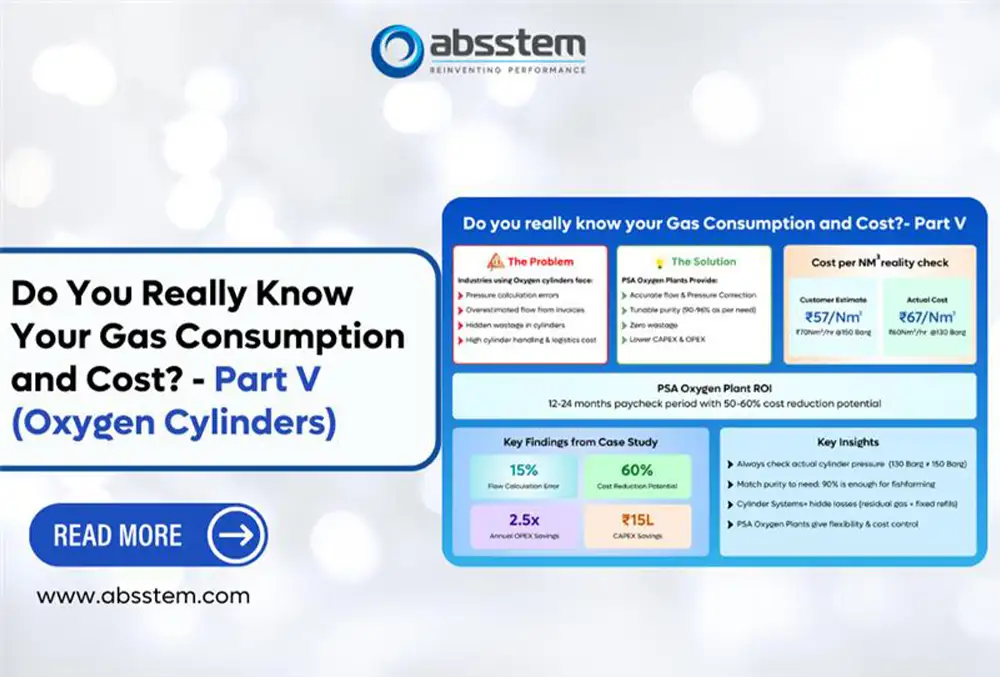
This article continues our blog series:
- Do We Really Know Our Gas Consumption and Cost? Part I (1)
- Do You Really Know Your Gas Consumption and Cost? – Part II (Liquid Nitrogen) (2)
- Do You Really Know Your Gas Consumption and Cost? – Part III (Nitrogen Cylinders) (3)
- Do You Really Know Your Gas Consumption and Cost? – Part IV (Liquid Oxygen) (4)
In this part, we explore the technical and financial aspects of using Oxygen Cylinders in industries.
In our last article, we highlighted the real cost of liquid oxygen in industrial applications. This time, we’ll focus on:
- Impact of cylinder pressure on actual consumption and procurement costs
- How Oxygen Cylinders are used in practice
- The hidden costs and wastage involved
- How PSA Oxygen Plants can dramatically reduce costs
Case Study: Fish Farming Industry Using Oxygen Cylinders for Oxygenation
A client from the Fish Farming Industry approached us with a requirement to set up a PSA Oxygen Plant.. Their initial request was:
- Oxygen Flow: 70 Nm³/hr
- Pressure at usage point: 6 Barg
- Purity required: 99.9%
To ensure that our proposal is technically in line with the customer’s specifications, we requested the customer to visit their facility to validate these requirements.
Our team visited the client site and conducted a detailed audit of the customer’s process, application, and associated gas requirements in terms of Oxygen flow, purity and required pressure at the point of use.
Since they were already using Oxygen Cylinders, we studied:
- Current cylinder usage patterns
- Replenishment and billing cycles
- Actual demand vs. estimated demand
- Oxygen Purity Analysis
- Oxygen purity required for Fish Farming: Above 90%
- Default Oxygen Cylinder Purity: 99.9% – higher than what was required.
- Oxygen Production Cost Difference in terms of purity
- Oxygen Purity Analysis
| Oxygen Type | Purity | Cost (₹/Nm³) |
| Oxygen Cylinder | 99.9% | ₹18.90 |
| PSA Oxygen Plant | 90-96% | ₹8.80 |
| VPSA Oxygen Plant | 90-96% | ₹4.40 |
Note: Electricity cost assumed at ₹8/unit.
- Key Insights
- 90-96% oxygen purity is widely acceptable in fish farming applications.
- PSA plants are designed in line with the required purity, thereby reducing production costs by 50% or more.
- Lower purity (when acceptable) also reduces maintenance + lifecycle costs.
- To read more about the cost implications of Oxygen purity, please read our blog titled, Comparison of the Cost of Oxygen Gas from Different Sources (5).
- Key Insights
- Oxygen Flow Calculation Error
To determine the Oxygen gas flow required for the application, we asked the customer to explain how they calculated the value mentioned in their RFQ (70 NM³/hr). They told us that they had reviewed their Oxygen Cylinders supplier’s invoice and divided the total Oxygen gas volume by the total working hours. While this method was theoretically acceptable, it overlooked one critical factor, the pressure of the Oxygen cylinder supplied by the vendor.
| Parameter | As per Invoice |
| Oxygen cylinders used per day | 240 |
| Oxygen cylinder cost | ₹400 |
| Oxygen cost per cubic meter | ₹57 |
| Oxygen consumption/hour | (240X7)/24 = 70 Nm³/hr |
| Monthly Transportation cost | ₹20,000/- |
What’s wrong with this data? As visible from the above, the client divided the Oxygen Cylinders’ volume directly by hours, ignoring the pressure of Oxygen inside the cylinder at the time of delivery to the client.
Pressure-Based Correction
Volume of gas stored in an Oxygen cylinder (46.4 L water volume) = Volume of cylinder (water
holding capacity) multiplied by the pressure of gas inside the cylinder.
As per the invoice, pressure inside the cylinder is 150 Barg,
Therefore, the gas inside one cylinder = 150 X 46.4 = ~7000 L or 7M³
But upon thorough inspection, it was observed that
The pressure of the cylinder was 130 Barg
Therefore, the gas inside one cylinder becomes 130 X 46.4 = ~6000 L or 6M³
- Invoice assumption (150 Barg cylinder pressure) → 7 Nm³/cylinder
- Actual observed: (130 Barg cylinder pressure) → 6 Nm³/cylinder
After factoring in the real gas inside the cylinder, we found the actual usage was much lower. Please look at the table below:
| Parameter | As per Invoice | After Correct Conversion | Calculation / Explanation |
| Oxygen used per hour | 70 Nm³/hr | 60 Nm³/hr | = (240 x 6)/24 = 60 Nm³ (1 Oxygen Cylinder contains 6 NM³ of Oxygen instead of 7 Nm³) |
| Oxygen cost | ₹400 / cylinder | ₹67/Nm³ | ₹400 ÷ 6 = ₹67 per Nm³ |
The above analysis clearly highlights a discrepancy of nearly 15% between the customer’s calculated Oxygen flow requirement and the actual flow required.
Pressure Normalisation for Accurate Oxygen Accounting
For accurate sizing and cost calculations, convert all invoiced units to Nm³ and verify the delivered cylinder pressure. Differences in unit basis (Sm³ vs Nm³) and actual cylinder pressure can significantly distort flow and cost per Nm³.
Quick checklist
- Confirm invoice unit & basis: If billing is done per cylinder, standardise it by converting the quantity into Nm³ of gas.
- Use cylinder specifications: Multiply the cylinder’s water volume by the delivered pressure to estimate the contained gas, then subtract the residual pressure that cannot be utilised.
- Standardise on one basis (Nm³): Convert kg/L/Sm³ to Nm³ before computing consumption, cost per Nm³, and plant sizing.
- Wastage and Losses with Oxygen Cylinders
- Another key factor to consider is the process losses that occur during the use of Oxygen Cylinders
Even after pressure correction, cylinder systems suffer hidden process losses:
- Residual Oxygen left inside cannot be used below 3 Barg
Fixed refilling cycles often ignore leftover oxygen in cylinders
Loss Calculation
| Parameter | Value |
| Minimum unusable Pressure | 3 Barg |
| Oxygen loss/cylinder | 3 x 46.4 = 0.139 Nm³ |
| Total loss for 10 cylinders per hour | 10 x 0.139 = 1.4 Nm³/hr |
Actual Oxygen Requirement (After Absstem Audit)
| # | Parameters | Corrected Values |
| 1 | Oxygen Flow (client estimate) | 70 Nm³/hr |
| 2 | Oxygen wastage | 1.39 Nm³/hr |
| 3 | Oxygen Flow Correction (due to low supplied pressure) | 60 Nm³/hr |
| 4 | Actual Oxygen flow required by the client (Sr.3-Sr.2) | 59 Nm³/hr |
Corrected Oxygen Requirement (After Absstem Visit)
| Parameter | Client Estimate | Absstem Recommendation |
| Oxygen Flow | 70 Nm³/hr | 59 Nm³/hr |
| Gas Pressure | 6 Barg | 3 Barg |
| Purity | 99.9% | 90% |
| Plant Cost | ₹90 Lakhs | ₹75 Lakhs |
| Annual Operational Cost | ₹115 Lakhs | ₹46 Lakhs |
As we can see, the difference was observable in terms of all parameters, i.e., flow, purity & wastage. The right choice of PSA Oxygen plant for this particular industry can save around 15% in capital expense and almost 2.5 times the operational cost, every year, in the case explained above.
If you calculate the lifecycle cost, taking into consideration the life of a PSA Oxygen plant is a minimum of 10 years, then we can easily say that the decision to buy the Oxygen plant as per the initial client data would have turned into an economic disaster.
Savings:
- ~15% Capex savings
- 2.5x Annual Opex savings
- Over a 10-year lifecycle results in multi-crore savings
Conclusion
This case highlights three key learnings:
- Check cylinder pressure (130 Barg vs 150 Barg) to avoid oversizing.
- Match purity with application requirements – higher purity ≠ better (unless it is needed).
- Account for wastage – Leftover gas losses in Oxygen Cylinders add hidden costs.
A PSA Oxygen Plant with 12-24 months ROI is a smarter, sustainable alternative to Oxygen Cylinder supply for different industries.
Consult Us
Looking to optimise your Oxygen cost? Contact our experts:
- Email: info@absstem.com
- Phone: 1800 547 0506
- Website: absstem.com
References
- Absstem Technologies. (2025). Do We Really Know Our Gas Consumption and Cost?
- Absstem Technologies. (2025). Do You Really Know Your Gas Consumption and Cost? – Part II (Liquid Nitrogen)
- Absstem Technologies. (2025). Do You Really Know Your Gas Consumption and Cost? – Part III (Nitrogen Cylinders)
- Absstem Technologies. (2025). Do You Really Know Your Gas Consumption and Cost? – Part IV (Liquid Oxygen)
- Absstem Technologies. (2025). Comparison of the Cost of Oxygen Gas from Different Sources