
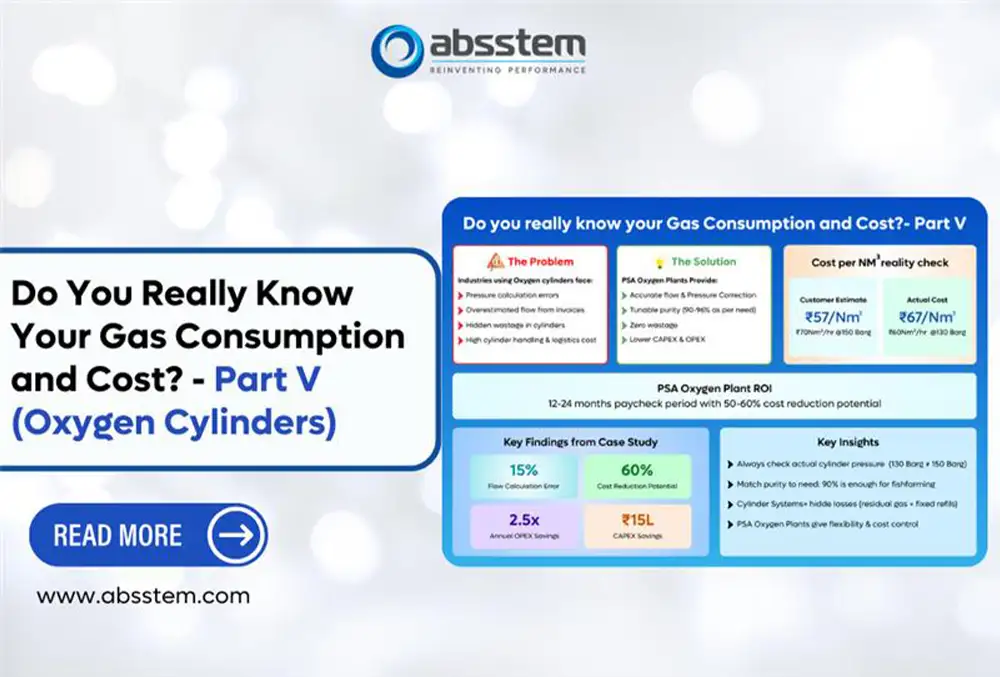
Most companies that buy oxygen in cylinders do not know their true consumption or cost per Nm³. Invoices assume every cylinder is full at 150 barg, ignore the gas left inside when it is returned, and quote 99.9% purity even when the process needs far less. In the case below, correcting those three errors turned a 70 Nm³/hr request into a 59 Nm³/hr PSA plant at 90% purity, cutting the plant price by about 15% and the yearly running cost from ₹115 lakh to ₹46 lakh.
This article is part of our series on real gas costs. Earlier parts covered gas consumption, liquid nitrogen, nitrogen cylinders and liquid oxygen.
The request: 70 Nm³/hr of 99.9% oxygen at 6 barg
A fish farm using oxygen cylinders for oxygenation asked for a PSA oxygen plant with:
- Oxygen flow: 70 Nm³/hr
- Pressure at point of use: 6 barg
- Purity: 99.9%
Before quoting, our team audited the site: cylinder use, refill and billing cycles, actual versus estimated demand, and the purity the process really needed.
Error 1: paying for purity the process does not need
Fish farming needs oxygen above 90%. Cylinders are supplied at 99.9% by default, so the client had specified 99.9% for the new plant too.
| Oxygen source | Purity | Production cost (₹/Nm³) |
|---|---|---|
| Oxygen cylinder | 99.9% | ₹18.90 |
| PSA oxygen plant | 90–96% | ₹8.80 |
| VPSA oxygen plant | 90–96% | ₹4.40 |
Power cost assumed at ₹8/unit.
Designing the plant for the purity the process needs cuts production cost by 50% or more, and also lowers maintenance and lifecycle cost. Read more in comparison of the cost of oxygen from different sources.
Error 2: assuming every cylinder is full
The client worked out 70 Nm³/hr by dividing the gas on their invoices by working hours:
| From the invoice | Value |
|---|---|
| Cylinders used per day | 240 |
| Price per cylinder | ₹400 |
| Assumed gas per cylinder | 7 Nm³ (at 150 barg) |
| Calculated flow | 240 × 7 ÷ 24 = 70 Nm³/hr |
| Cost per Nm³ | ₹57 |
| Transport per month | ₹20,000 |
The gas in a cylinder depends on the pressure it is actually delivered at:
Gas in a cylinder = water volume × pressure
- At the invoiced 150 barg: 46.4 L × 150 = about 7 Nm³
- At the measured 130 barg: 46.4 L × 130 = about 6 Nm³
With 6 Nm³ per cylinder, real use was 240 × 6 ÷ 24 = 60 Nm³/hr, and the real cost was ₹400 ÷ 6 = ₹67 per Nm³, not ₹57. The client had overestimated flow by about 15% and underestimated cost.
Error 3: forgetting the gas left in returned cylinders
Cylinders cannot be emptied below about 3 barg, so every returned cylinder still holds oxygen the client paid for but never used.
| Loss calculation | Value |
|---|---|
| Minimum usable pressure | 3 barg |
| Oxygen left per cylinder | 46.4 L × 3 = 0.139 Nm³ |
| Cylinders used per hour | 10 |
| Oxygen lost per hour | about 1.4 Nm³/hr |
So the oxygen the process actually used was about 60 − 1.4 = 59 Nm³/hr.
The result
| Parameter | Client’s estimate | After Absstem’s audit |
|---|---|---|
| Oxygen flow | 70 Nm³/hr | 59 Nm³/hr |
| Purity | 99.9% | 90% |
| Plant cost | ₹90 lakh | ₹75 lakh |
| Annual operating cost | ₹115 lakh | ₹46 lakh |
That is about 15% less capital and about 2.5 times lower running cost every year. Over a PSA plant’s life of at least 10 years, the saving runs into crores. Buying the plant as first specified would have locked in those losses for a decade.
How to check your own cylinder costs
- Convert everything to Nm³. If you are billed per cylinder, work out the gas per cylinder from its water volume and delivered pressure.
- Measure the delivered pressure. Do not assume 150 barg.
- Subtract the residual gas left in each returned cylinder.
- Check the purity your process needs, not the purity the cylinder happens to have.
- Add transport, rental and handling to get the true cost per Nm³.
Why on-site PSA oxygen pays back
- Lower cost per Nm³: typically 50–90% less than cylinders or liquid oxygen, depending on purity and power cost.
- No logistics: no deliveries, rentals or cylinder handling, and no supply disruptions.
- Safety: oxygen at about 5.5 barg instead of 150 barg cylinders on the shop floor.
- Control: you decide flow and purity, and oxygen is there whenever the process needs it.
- Lower emissions: no delivery trucks.
Most PSA oxygen plants pay back in 12–24 months against cylinders. Use the free ROI calculator to check yours, or read the PSA oxygen generator engineering guide.
Get an audit of your oxygen use
Send us your cylinder invoices and we will work out your true consumption and the right plant size. See Idos industrial oxygen generators, email info@absstem.com or call 1800 547 0506.