
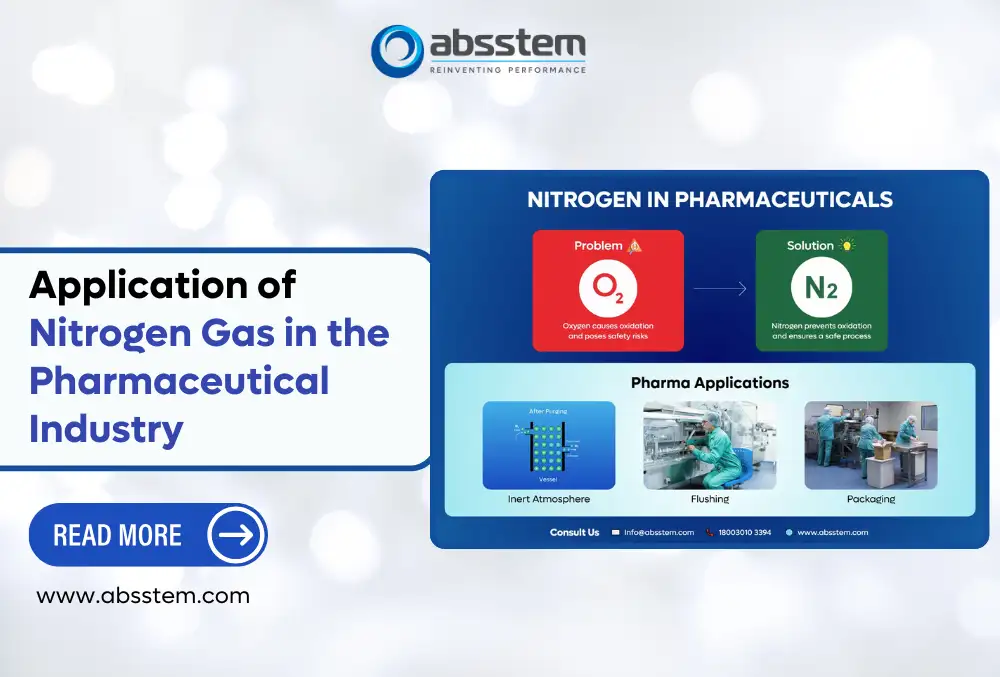
Nitrogen gas is one of the most widely used industrial gases in the pharmaceutical industry, valued for its inertness, dryness, and cost-effectiveness. From creating oxygen-free environments to extending the shelf life of medicines, nitrogen ensures compliance with FDA regulations, product stability, and operational safety.
In this article, we explore the key applications, purity requirements, sources, and benefits of nitrogen gas in pharmaceutical manufacturing – along with why PSA nitrogen generators are now the most sustainable and economical choice.
What is the Pharmaceutical Industry?
The pharmaceutical industry encompasses the research, development, manufacturing, and distribution of drugs and medicines for healthcare purposes. Processes are highly regulated to ensure safety, quality, and efficacy. Gases like nitrogen play a critical role in maintaining the controlled environments needed for pharmaceutical production.
Why is Nitrogen Used in the Pharmaceutical Industry?
Nitrogen is an inert gas with extremely low oxygen and moisture content. It is not directly involved in drug formulation but is essential in purging, flushing, inerting, and packaging.
- Inert Atmosphere (Purging): Nitrogen, due to its inert properties, is used to purge the air (oxygen) inside reactors, storage tanks, pipelines, and other equipment, thereby maintaining an inert environment during production and product transfer. In short, it prevents oxygen from entering reactors, pipelines, and tanks.
- Prevents Oxidation: Protects active ingredients and final products from degradation due to the removal of oxygen from the reactor and storage tanks
- Fire Hazard Reduction: Removes oxygen, minimising explosion and fire risks within the reactor
- Controlled Reactions: Ensures precise chemical reactions without unwanted side reactions due to the inert atmosphere inside the reactor.
- Flushing: In case of any emergency or sudden increase in oxygen content during pharmaceutical production, the whole system is flushed with huge quantities of nitrogen gas to remove the oxygen and prevent wastage of product or raw material.
- Packaging: Maintains product stability, extends the shelf life of medicines by eliminating oxygen and moisture as nitrogen is purged into the final packets to remove moisture and oxygen.
Apart from Nitrogen, can we use other gases for the Pharmaceutical Industry?
The right answer is yes. Theoretically, inert gases like argon and helium can also be used. The differences lie in the cost of production of these gases.
Cost of production of Nitrogen ~ 100 times < Cost of production of Argon
Cost of production of Nitrogen ~ 1000 times < Cost of production of Helium
Therefore, Nitrogen becomes the best solution. The reason for the low cost of production of nitrogen is the availability of abundant nitrogen (78%) in the atmosphere.
To understand more about the cost of production of nitrogen via PSA nitrogen generators, please read our blog titled, Understanding Nitrogen Purity in PSA Nitrogen Generators Understanding Nitrogen Purity in PSA Nitrogen Generators (1).
What is the purity of Nitrogen required for Pharmaceutical Applications?
The purity of nitrogen gas for pharmaceutical production varies between 99.9% and 99.999% depending on the regulations by the FDA, but generally, a nitrogen purity of 99.9% is required for purging, where these purities of nitrogen signify the oxygen content in nitrogen.
To get more clarity about the purity of nitrogen gas, please read our blog titled, Understanding Nitrogen Purity in PSA Nitrogen Generators (1).
How much Nitrogen is required for the Pharmaceutical Industry?
The volume of nitrogen required for this process is not constant and varies over time.
It sometimes also requires a sudden flush of nitrogen for certain periods of time. Therefore, please consult the OEM of the equipment before deciding the quantity of nitrogen required.
In the meantime, please read our blog titled, How to Select the Right Nitrogen Plant for Varying Nitrogen Requirement: Part II (2) to know more.
What is the Nitrogen pressure required for the Pharmaceutical Industry?
Pharmaceutical applications typically require nitrogen at 2-6 Barg, with occasional higher pressures for specific processes.
What are the Different Sources of Nitrogen in the Pharmaceutical Industry?
Traditionally, liquid nitrogen tanks or nitrogen cylinders were used as a source of nitrogen gas for Pharmaceutical industry applications, but with advancements in technology, Nitrogen nowadays is produced on-site via PSA nitrogen generators, which separate nitrogen from atmospheric air.
The cost of nitrogen reduces drastically when produced via a PSA nitrogen generator. The table below shows the cost of Nitrogen from different sources:
| S. No. | Source | Cost of Nitrogen per Nm3/hr (₹) | Pressure of Nitrogen |
| 1 | Nitrogen Cylinders | 75-100 | Up to 200 Barg |
| 2 | Liquid Nitrogen | 15-30 | Up to 20 Barg |
| 3 | PSA Nitrogen Generator | 2.65 | Up to 200 Barg |
Please note: Nitrogen from the PSA nitrogen generator is produced at a pressure of around 8 Barg, and it is then pressurised via a booster to the required nitrogen pressure. The cost of boosting is comparatively low compared to the generation cost, so we have ignored it in the above table.
To read more about the cost of different sources of nitrogen, please read our blog titled, How to calculate the ROI (Return on Investment) of PSA Nitrogen Generator compared to Liquid Nitrogen or Nitrogen Cylinders How to calculate the ROI (Return on Investment) of PSA Nitrogen Generator compared to Liquid Nitrogen or Nitrogen Cylinders (3).
Can High-Purity Nitrogen of 99.99 or 99.999% be used for Pharmaceutical Applications?
In most cases, 99.9% nitrogen gas is used in the Pharmaceutical Industry. This will cost you around ₹2.6/- per cubic meter when produced via PSA Nitrogen Generator.
The cost of nitrogen production via PSA technology varies significantly as we move from lower to higher purity. This is mainly because producing higher-purity Nitrogen requires more energy (High amount of compressed air).
For example, generating nitrogen at 95% purity requires significantly less power than producing nitrogen at 99.9990% purity, since removing the final traces of oxygen from the gas mixture is an energy-intensive process.
The table below shows how electricity consumption affects the cost of production of nitrogen at different purity levels, assuming the cost of electricity as ₹8/- per unit, as per our blog titled, Understanding Nitrogen Purity in PSA Nitrogen Generators (1).
Table 2: Cost of Nitrogen used for Pharmaceutical Applications
| Nitrogen Purity | Power Consumption (kW/Nm³) | Cost of Nitrogen per Nm3/hr (₹) |
| 95.0000% | 0.22 | 1.76 |
| 99.0000% | 0.30 | 2.40 |
| 99.9000% | 0.33 | 2.64 |
| 99.9900% | 0.60 | 4.80 |
| 99.9950% | 0.80 | 6.40 |
| 99.9990% | 1.06 | 8.48 |
| 99.9995% | 1.32 | 10.56 |
As the table shows, the power consumption and, consequently, the cost increase as nitrogen purity rises.
For instance, producing nitrogen at 95% purity costs ₹1.76 per Nm³, whereas producing 99.9995% purity nitrogen costs ₹10.56 per Nm³. This significant difference highlights the need to carefully match the nitrogen purity level to the application requirements to optimise costs.
Higher purity = Higher electricity consumption = Higher cost
Why PSA Nitrogen Generators are the preferred choice for Pharmaceutical applications?
Compared to the traditional sources of nitrogen gas like cylinders or liquid tanks, PSA nitrogen generators are far more beneficial for the Pharmaceutical industry. Below are the benefits of the PSA Nitrogen generator over traditional sources like cylinders or liquid nitrogen:
- Compact Size: Compact PSA Nitrogen generators are help in saving a lot of space compared to liquid tanks
- Fully automatic systems: As advanced PSA nitrogen generators are fully automatic with auto stop and IDLE features, these systems prove to be a boon for Pharmaceutical applications as nitrogen usage is not constant and varies with time. PSA nitrogen generators go into IDLE mode during low usage of nitrogen to save energy.
- In-house Nitrogen generation: As Nitrogen is produced on-site in PSA nitrogen generators from compressed air, there is no dependency on 3rd party vendors and logistics for refilling of gas, like in the case of cylinders or liquid tanks.
- Reduction in carbon emission: As nitrogen is produced onsite in PSA nitrogen generators, there is no logistics involved, hence carbon emission is negligible.
- Low cost of Nitrogen: Nitrogen produced by the PSA nitrogen generator is at least 5 times cheaper than other sources.
Conclusion
The pharmaceutical industry demands strict quality, safety, and regulatory compliance. Nitrogen gas plays a critical role in ensuring an inert, safe, and controlled environment for drug production, packaging, and storage. This is more so the case, considering there are strict regulations especially considering that the products are manufactured for human consumption.
With PSA nitrogen generators, pharmaceutical companies can now ensure cost efficiency, sustainability, and uninterrupted supply, while meeting stringent purity requirements.
While traditional nitrogen sources like liquid nitrogen and cylinders are still used, on-site PSA nitrogen generators have emerged as a cost-effective and sustainable alternative. Understanding the specific requirements of nitrogen for the Pharmaceutical industry allows industries to optimise operations and reduce expenses.
Consult Us
For tailored solutions and cost-efficient nitrogen for Pharmaceutical industry setups, please schedule a consultation with us.
- Email: [email protected]
- Phone: 1800 3010 3394
- Website: absstem.com
References
- Absstem Technologies. (2024). Understanding Nitrogen Purity in PSA Nitrogen Generators
- Absstem Technologies. (2025). How to Select the Right Nitrogen Plant for Varying Nitrogen Requirement: Part II
- Absstem Technologies. (2024). How to calculate the ROI (Return on Investment) of PSA Nitrogen Generator compared to Liquid Nitrogen or Nitrogen Cylinders