
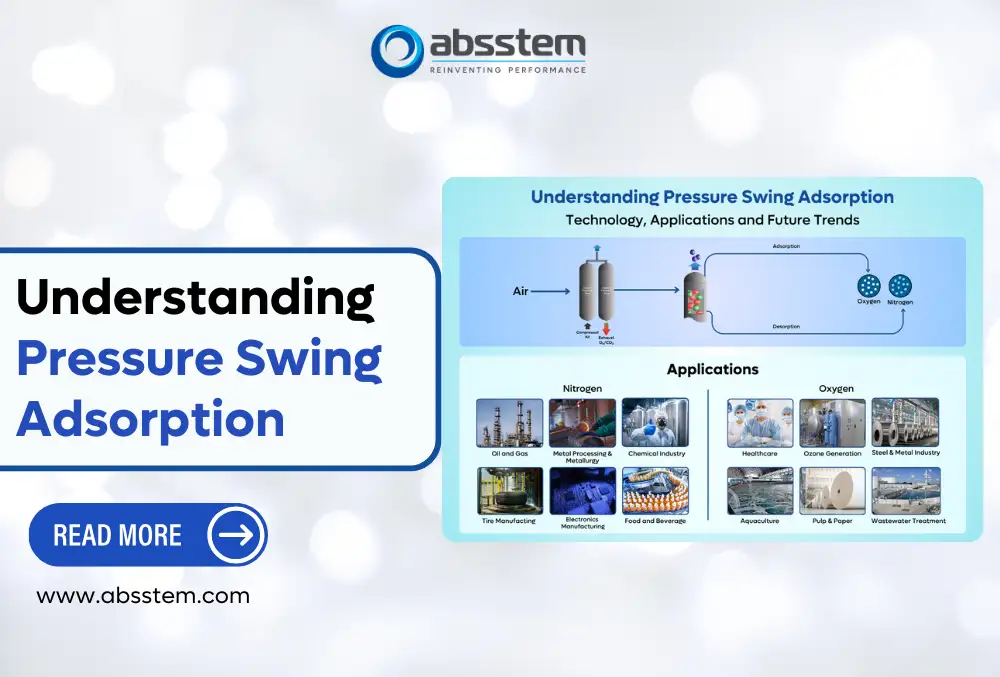
Pressure swing adsorption (PSA) separates gases by trapping some molecules on a solid adsorbent under pressure and releasing them when the pressure drops. The same principle, with different adsorbents, is used to make oxygen and nitrogen from air, purify hydrogen, upgrade biogas to biomethane and capture carbon dioxide. It needs no chemicals, runs on electricity, and can be built for anything from a small clinic to a large industrial plant.
This guide covers which adsorbent does which job, where PSA is used, how it compares with other separation methods, and where the technology is heading. For the step-by-step cycle, read the working principle of pressure swing adsorption.
How PSA works, in short
A PSA unit has at least two towers packed with adsorbent. Compressed gas enters one tower, where the unwanted components stick to the adsorbent and the wanted gas passes through. When the adsorbent is full, the tower is depressurised so the trapped gas is released and vented. The towers alternate, with pressure equalisation and a small purge between steps, so product flows continuously.
Adsorbents and what they do
| Adsorbent | What it removes | Used for |
|---|---|---|
| Zeolite molecular sieve | Nitrogen (from air) | Oxygen generation, 90–96% purity |
| Carbon molecular sieve (CMS) | Oxygen (from air), by faster diffusion into its pores | Nitrogen generation, 95–99.999% purity |
| Activated alumina | Moisture | Protective layer in oxygen and nitrogen towers |
| Activated carbon | Hydrocarbons and oil vapour | Pre-treatment and hydrogen purification beds |
| Layered beds (several adsorbents) | CO₂, CO, CH₄, H₂O and other impurities | Hydrogen purification and biogas upgrading |
Where PSA is used
| Method | How it separates | Best suited to |
|---|---|---|
| PSA | Adsorption at pressure, release at low pressure | On-site oxygen and nitrogen, hydrogen purification, biogas upgrading; small to large capacities |
| Cryogenic distillation | Liquefies air and distils it by boiling point | Very large volumes, and plants that need liquid products or argon |
| Membranes | Some gases pass through hollow fibres faster than others | Simple, lower-purity nitrogen; more compressed air needed at high purity |
| Chemical absorption | A liquid solvent reacts with the unwanted gas | Large-scale CO₂ removal; needs solvents and heat to regenerate |
Learn more about specific uses:
- PSA oxygen generators
- PSA nitrogen generators
- Nitrogen in green hydrogen production
- Biogas upgradation and CO₂ removal
PSA vs other separation methods
| Method | How it separates | Best suited to |
| PSA | Adsorption at pressure, release at low pressure | On-site oxygen and nitrogen, hydrogen purification, biogas upgrading; small to large capacities |
| Cryogenic distillation | Liquefies air and distils it by boiling point | Very large volumes, and plants that need liquid products or argon |
| Membranes | Some gases pass through hollow fibres faster than others | Simple, lower-purity nitrogen; more compressed air needed at high purity |
| Chemical absorption | A liquid solvent reacts with the unwanted gas | Large-scale CO₂ removal; needs solvents and heat to regenerate |
PSA’s main advantages are that it runs at near-ambient temperature, uses no chemicals, starts quickly, and produces gas on site, so there is no transport or bulk storage.
Challenges and how they are handled
- Moisture and oil: they damage adsorbents. Dryers, filters and an activated alumina layer protect the bed.
- Adsorbent ageing: performance falls if the air is not kept clean. With good pre-treatment, sieves last many years.
- Maintenance: routine filter, valve and compressor care keeps purity and output steady. Monitoring pressure, flow and purity helps spot issues early.
Where adsorption is heading
Research is widening what adsorption can do:
- New adsorbents: coated and synthetic materials with higher capacity and selectivity, which could make PSA viable for more gas pairs.
- Hybrid processes: combining pressure, vacuum and temperature swings (VPSA, TSA) to separate more than one component at once.
- Better adsorber design: more surface area and better packing for higher efficiency.
- New applications: direct air capture of CO₂, argon recovery from air, and removing pollutants from industrial exhaust.
If adsorption can be refined to separate several gases at once, as cryogenic plants do, it could make industrial gases at a much lower cost than today.
Talk to us
Absstem designs PSA oxygen and nitrogen generators. Email info@absstem.com or call 1800 547 0506.