
Introduction
Nitrogen cylinders are everywhere in industry: purging pipelines, pressure and leak testing, food packaging, laser cutting, laboratories and maintenance shops. Yet many buyers do not know how much nitrogen they actually get in a cylinder, how much of it they can really use, or what each cubic metre costs them.
This guide explains nitrogen cylinder pressure and sizes, shows how to calculate the gas inside, explains why the usable amount is lower than the label suggests, and compares the cost with on-site nitrogen generation.
Nitrogen Cylinder Pressure
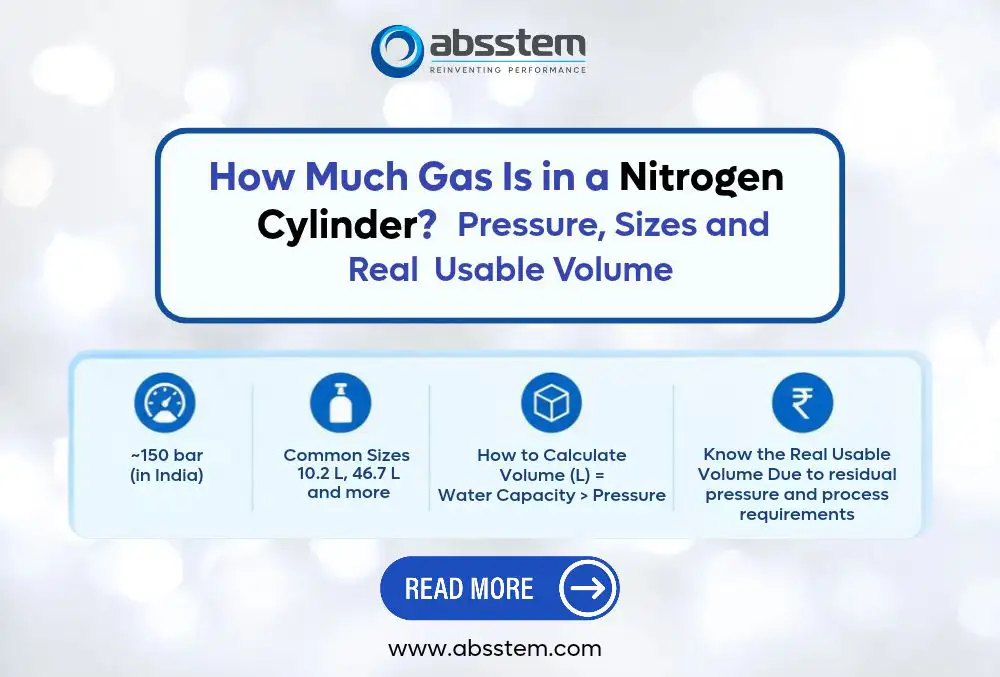
In India, industrial nitrogen cylinders are commonly filled to about 150 bar (about 150 kg/cm², or roughly 2,200 psi) (1). Some newer cylinders are rated for higher pressures such as 200 bar; the working pressure is always stamped on the cylinder shoulder. Never fill or use a cylinder above its stamped working pressure.
Process pressure is a different thing. The pressure your application needs (for example, 6–8 bar for purging or packaging, or much higher for laser cutting) is set by the regulator, not by the cylinder. Our guide to nitrogen pressure by application covers this (2).
How to Calculate the Gas in a Nitrogen Cylinder
You need two numbers, both stamped on the cylinder: the water capacity (internal volume in litres) and the filling pressure (bar). Then (1):
Volume of gas (litres) = Water capacity (litres) × Pressure (bar)
For the common 46.7-litre cylinder filled to 150 bar:
46.7 L × 150 bar = 7,005 litres ≈ 7 m³ of nitrogen
That is why one standard nitrogen cylinder is usually quoted as “about 7 m³” (3). The formula treats nitrogen as an ideal gas, which is close enough for nitrogen at normal cylinder pressures.
Gas content at different pressures
| Gauge Pressure (bar) | 46.7 L Cylinder: Gas (litres) | 46.7 L Cylinder: Gas (m³) | 10.2 L Cylinder: Gas (litres) |
|---|---|---|---|
| 200 | 9,340 | 9.3 | 2,040 |
| 150 | 7,005 | 7.0 | 1,530 |
| 140 | 6,538 | 6.5 | 1,428 |
| 130 | 6,071 | 6.1 | 1,326 |
| 120 | 5,604 | 5.6 | 1,224 |
| 110 | 5,137 | 5.1 | 1,122 |
| 100 | 4,670 | 4.7 | 1,020 |
Table 1: Nitrogen in a cylinder at different pressures (200 bar applies only to cylinders rated for it)
The gas content falls in direct proportion to the pressure. A cylinder delivered at 130 bar instead of 150 bar holds about 13% less nitrogen for the same price, so check the gauge when cylinders arrive.
The Real Usable Volume
You never get all 7 m³ out of a cylinder. Three things reduce what you actually use:
- Residual pressure. Cylinders are returned with some pressure left inside, both because regulators stop delivering steady flow at low pressure and to keep moisture and dirt out. If a 46.7 L cylinder goes back at 10 bar, 467 litres (about 7%) goes back with it: you used 6,538 litres, not 7,005.
- Process minimum pressure. If your process needs, say, 20 bar at the regulator outlet, the cylinder becomes “empty” for you well before it reaches zero. Returned at 20 bar, a 46.7 L cylinder leaves 934 litres (about 13%) unused.
- Under-filling. As above, a cylinder filled to 130 bar instead of 150 bar is already 13% short before you start.
| Cylinder Returned At | Nitrogen Used (litres) | Nitrogen Returned Unused | Real Cost per Nm³ (₹700 per Cylinder) |
|---|---|---|---|
| 0 bar (theoretical) | 7,005 | 0% | ₹100 |
| 10 bar | 6,538 | 7% | ₹107 |
| 20 bar | 6,071 | 13% | ₹115 |
| 30 bar | 5,604 | 20% | ₹125 |
Table 2: Usable nitrogen and real cost per Nm³ for a 46.7 L cylinder filled to 150 bar
What Cylinder Nitrogen Really Costs
Cylinder nitrogen in India typically costs ₹70–150 per Nm³, depending on location (3). On top of the gas, you pay for cylinder rent, transport and the people who receive, change and track cylinders. Compare that with on-site PSA nitrogen at ₹1.76–10.56 per Nm³, depending on purity (3)(4).
Worked example: 20 cylinders a day
We ran a typical case through the free Absstem ROI calculator (PSA vs Cylinders): 20 nitrogen cylinders a day of 7 m³, at ₹700 per cylinder, 24 hours a day, 30 days a month, with the process needing 99.9% purity.
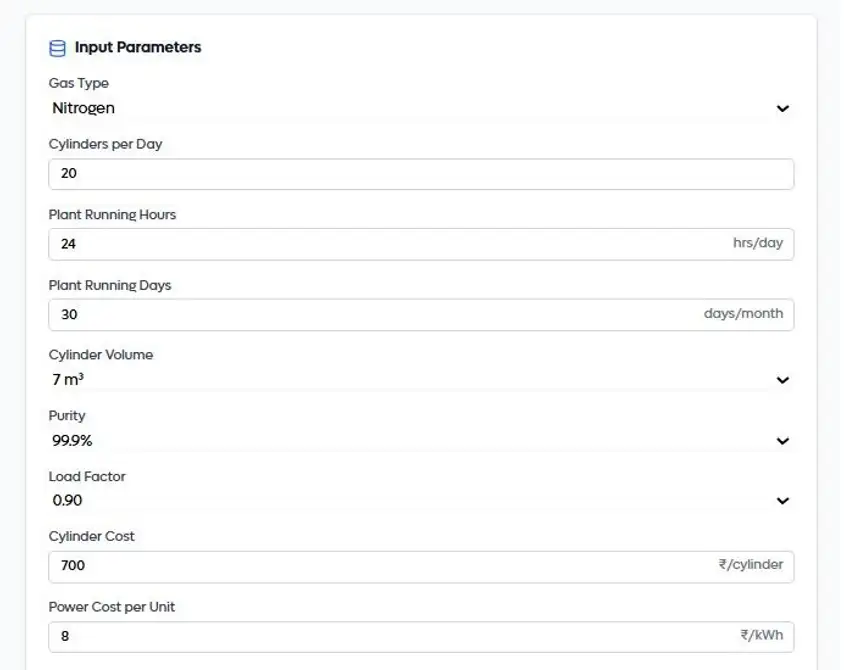
a day, 7 m³, 99.9% purity, ₹700 per cylinder.
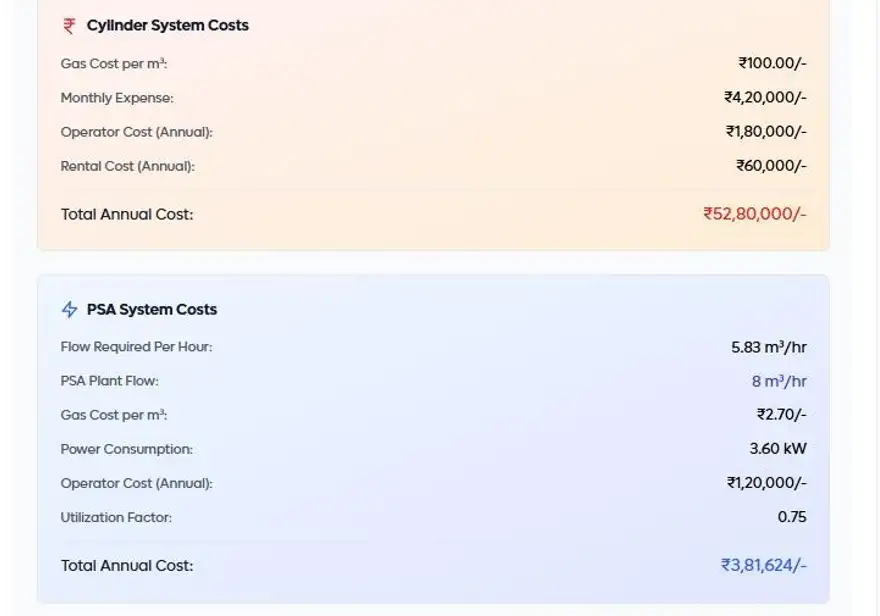
| Nitrogen Cylinders | PSA Nitrogen Generator | |
|---|---|---|
| Nitrogen per day | 20 × 7 = 140 m³ | 140 m³ (about 5.8 m³/hr) |
| Cost per m³ | ₹700 ÷ 7 = ₹100 | About ₹2.70 |
| Total cost per year (calculator) | ₹52,80,000 | ₹3,81,624 |
Table 3: 20 cylinders a day – cylinders vs PSA nitrogen generator (Absstem ROI calculator; cylinder cost includes operator and rental)
In this example, a small on-site generator saves about ₹49 lakh a year, before counting the unused gas returned in every cylinder. Run your own numbers in your proprietary Absstem ROI Savings calculator here.
Purity: Paying for More Than You Need
Cylinder nitrogen is usually supplied at a very high purity, typically 99.999% or more (3). Many applications, such as purging, blanketing, food packaging and pressure testing, need far less. An on-site PSA generator lets you choose the purity your process needs, and lower purity means a lower cost per Nm³. See our guide to nitrogen purity grades (5).
When Cylinders Still Make Sense
- Very low or occasional use, such as a few cylinders a month
- Portable work at different sites
- Backup supply for an on-site generator
For anything more than occasional use, an on-site PSA nitrogen generator usually pays for itself quickly, with no deliveries, no empty cylinders to return and no gas sent back unused.
Safety Reminders
- Store cylinders upright and chained; keep valve caps on during transport.
- Always use a pressure regulator rated for the cylinder pressure.
- Use nitrogen only in well-ventilated areas: nitrogen displaces oxygen and can cause asphyxiation without warning.
- Check the hydrostatic test date stamped on the cylinder before use.
Internal Resources – Next Steps
If you have completed your PESO research and are now ready to evaluate PSA oxygen plant options for your filling station:
- nGENX – Compact PSA Nitrogen Generator for SMEs and cylinder users
- nGEN – PSA Industrial Nitrogen Generator
Consult Us
For high-purity oxygen generation systems contact us:
- Email: info@absstem.com
- Phone: 1800 547 0506
- Website: absstem.com
References
- Absstem Technologies. (2024). Calculation of Volume of Gas Stored in a High-Pressure Cylinder
- Absstem Technologies. (2025). Nitrogen Pressure Required for Different Industrial Applications
- Absstem Technologies. (2025). Comparison of the Cost of Nitrogen Gas from Different Sources
- Absstem Technologies. (2024). Understanding Nitrogen Purity in PSA Nitrogen Generators
- Absstem Technologies. (2026). Nitrogen Purity Grades Explained: N2.0 to N6.0 and What Each Is Used For