
Introduction
Ask a gas supplier for “grade 5 nitrogen”, a laser-cutting machine maker for “99.999%”, and a food packer for “nitrogen with less than 1% oxygen”, and you may be talking about three very different gases. The grade names (N2.0, N4.0, N5.0 and so on) are shorthand for purity, and the purity you choose decides both whether your process works and how much you pay for every cubic metre.
This guide explains what each nitrogen grade means, how much oxygen it contains, which applications need which grade, and how the cost of producing nitrogen on site rises with purity.
How Nitrogen Grades Are Named
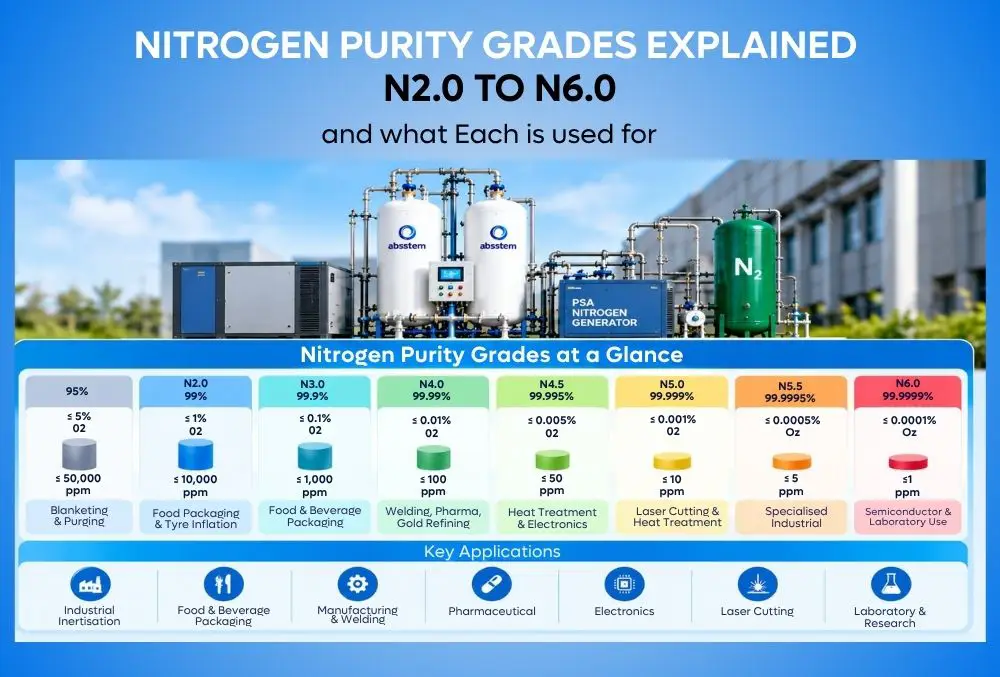
The grade name counts the nines in the purity. The number before the decimal point is the number of nines; the number after it is the last digit.
- N2.0 = 99% (two nines)
- N3.0 = 99.9% (three nines)
- N4.0 = 99.99% (four nines)
- N4.5 = 99.995% (four nines followed by a 5)
- N5.0 = 99.999% (five nines)
- N5.5 = 99.9995%
- N6.0 = 99.9999% (six nines)
In everyday terms, “grade 5” or “N5” nitrogen means 99.999% purity. For a closer look at what grade 5 really means in practice, see our Myth vs Reality: Grade 5 Nitrogen post (1).
Purity, Oxygen Content and ppm
Nitrogen purity is really a measure of how much oxygen is left in the gas. Argon, which makes up about 1% of air, travels with nitrogen through a PSA generator, but argon is inert like nitrogen, so it does not affect any application that uses nitrogen for its inertness. What matters is oxygen (2).
| Grade | Nitrogen purity (%) | Oxygen content (%) | Oxygen content (ppm) |
|---|---|---|---|
| – | 95.0000 | ≤ 5 | ≤ 50,000 |
| N2.0 | 99.0000 | ≤ 1 | ≤ 10,000 |
| N3.0 | 99.9000 | ≤ 0.1 | ≤ 1,000 |
| N4.0 | 99.9900 | ≤ 0.01 | ≤ 100 |
| N4.5 | 99.9950 | ≤ 0.005 | ≤ 50 |
| N5.0 | 99.9990 | ≤ 0.001 | ≤ 10 |
| N5.5 | 99.9995 | ≤ 0.0005 | ≤ 5 |
| N6.0 | 99.9999 | ≤ 0.0001 | ≤ 1 |
Table 1: Nitrogen grades with their maximum oxygen content in percent and parts per million (ppm)
A useful rule of thumb: every extra nine cuts the oxygen content by a factor of ten. Going from 99.9% to 99.999% does not sound like much, but it means going from 1,000 ppm of oxygen to just 10 ppm.
Which Grade Does Your Application Need?
Different processes need different purities. Lower purities are enough wherever nitrogen simply has to push oxygen out of the way; very high purities are needed where even traces of oxygen cause oxidation, discolouration or defects (2).
| Nitrogen purity | Typical applications |
|---|---|
| 95% | Blanketing, purging, inertisation, enhanced oil recovery |
| 99% (N2.0) | Food packaging, tyre inflation |
| 99.9% (N3.0) | Food and beverage packaging (modified atmosphere packaging) |
| 99.99% (N4.0) | Gold refining, tyre manufacturing, welding, pharmaceutical processes, cable curing |
| 99.995% (N4.5) | Heat treatment, electronics manufacturing |
| 99.999% (N5.0) | Laser cutting (oxide-free edges), heat treatment, electronics manufacturing |
| 99.9999% (N6.0) | Ultra-high-purity uses such as semiconductor and specialised laboratory work |
Table 2: Typical nitrogen purity by application
Two common examples: food packaging typically uses about 99.9% nitrogen, which is enough to stop oxidation and keep products fresh, while laser cutting of stainless steel needs about 99.999% so the cut edge stays bright with no burn marks (2). Always confirm the exact purity with your equipment maker or quality team, because over-specifying purity costs money every day.
How Purity Changes the Cost of Nitrogen
On-site PSA nitrogen generators can make nitrogen at any purity from about 95% to 99.9995% from the same technology (2). The trade-off is energy: removing the last traces of oxygen needs much more compressed air per cubic metre of nitrogen, and compressed air is where almost all the electricity goes (3).
| Nitrogen purity | Grade | Energy (kWh/Nm³) | Cost per Nm³ at ₹8/kWh |
|---|---|---|---|
| 95.0000% | – | 0.22 | ₹1.76 |
| 99.0000% | N2.0 | 0.30 | ₹2.40 |
| 99.9000% | N3.0 | 0.33 | ₹2.64 |
| 99.9900% | N4.0 | 0.60 | ₹4.80 |
| 99.9950% | N4.5 | 0.80 | ₹6.40 |
| 99.9990% | N5.0 | 1.06 | ₹8.48 |
| 99.9995% | N5.5 | 1.32 | ₹10.56 |
Table 3: Energy use and cost of nitrogen from PSA Plant at different purities (Absstem data, power at ₹8 per kWh)
Producing 99.9995% nitrogen costs about six times as much as producing 95% nitrogen. That is why matching purity to the real need of the process is the single biggest lever on your nitrogen bill.
A quick example
A plant uses 50 Nm³/hr of nitrogen, 24 hours a day, 30 days a month: 36,000 Nm³ a month. At 99.9% purity, PSA nitrogen costs ₹2.64 per Nm³, or about ₹95,000 a month. If the same plant specifies 99.999% “to be safe”, the cost rises to ₹8.48 per Nm³, or about ₹3,05,000 a month: an extra ₹2.1 lakh every month for purity the process may not need.
Cylinders and Liquid Nitrogen: One Grade for Everyone
Delivered nitrogen (high-pressure cylinders and liquid nitrogen) usually comes at a very high purity, typically 99.999% to 99.9998% (4). That sounds like a benefit, but it means every user pays for ultra-high purity even when their process only needs 99% or 99.9%. Delivered nitrogen also costs far more per Nm³: about ₹13–25 for liquid nitrogen and ₹70–150 for cylinders, against ₹1.76–10.56 for PSA nitrogen depending on purity (4).
Beyond N5.5: When to Add a Deoxo
For the highest purities, a PSA generator can be paired with a catalytic Deoxo unit. The PSA makes nitrogen at a lower purity and the Deoxo removes the remaining oxygen by reacting it with a small dose of hydrogen, followed by drying. At larger flows this is often cheaper to run than pushing a PSA alone to ultra-high purity. Our Deoxo post (5) and the PSA vs PSA + Deoxo calculator show when it makes sense.
How to Choose the Right Grade
- Find out the maximum oxygen (in ppm) your process can tolerate. Ask your equipment maker or quality team.
- Convert it to a purity using Table 1.
- Add a sensible margin, but do not jump a whole grade “to be safe”.
- Check whether different points of use need different purities. One PSA generator can feed them, or two smaller generators can.
- Work out the cost at your power tariff with Table 3 or the Absstem calculators.
Internal Resources – Next Steps
- nGEN – PSA Industrial Nitrogen Generator
- nGENX – Compact PSA Nitrogen Generator for SMEs
- Free ROI Calculators – including PSA vs PSA + Deoxo
Consult Us
For PSA oxygen and nitrogen generators sized to your plant, contact us:
- Email: info@absstem.com
- Phone: 1800 547 0506
- Website: absstem.com
References
- Absstem Technologies. (2025). Myth vs Reality: Grade 5 Nitrogen.
- Absstem Technologies. (2024). Understanding Nitrogen Purity in PSA Nitrogen Generators.
- Absstem Technologies. (2025). Operational Cost Versus Capital Cost of a PSA Oxygen or Nitrogen Plant.
- Absstem Technologies. (2025). Comparison of the Cost of Nitrogen Gas from Different Sources.
- Absstem Technologies. (2025). Deoxo Nitrogen Generators for Ultra-Pure Production.