
Introduction
The most common and expensive question entrepreneurs ask when planning an oxygen cylinder refilling business in India is: “Do I need a PESO licence?” The honest answer is: it depends on exactly what you are doing – and getting this wrong in either direction costs you. Get it wrong in one direction, and you spend months waiting for approvals you didn’t actually need, delaying your launch and your revenue.
Get it wrong in the other direction, and you start filling cylinders without mandatory PESO notification, exposing yourself to shutdown notices, penalties, and – in the worst case – a serious safety incident with no regulatory cover. This guide explains, clearly and precisely, what PESO requires for oxygen cylinder filling in India – based on the Gas Cylinders Rules 2016 and official PIB guidance. We have sourced every requirement from government primary sources, linked below.
Note: This guide is Part 2 of a three-part series on starting an oxygen cylinder refilling business in India:
- Part 1: How to Start an Oxygen Cylinder Refilling Business in India (2026 Complete Guide) (1)
- Part 2: PESO Licence for Oxygen Cylinder Filling Station – What You Actually Need (this guide)
- Part 3: Medical Oxygen Refilling vs Industrial Oxygen Refilling – Key Differences India (2026) (2) (This guide will also be written after this)
Source & Attribution Note: This article is a summarised and reworded version of information published by the Petroleum and Explosives Safety Organisation (PESO) and other referenced sources. The content presented here is intended to simplify and consolidate publicly available regulatory information for easier understanding. The information in this article should not be considered original research, technical guidance, or regulatory content developed by Absstem. Readers should refer to the original government sources and applicable regulations for authoritative and current requirements.
The Single Most Important Distinction – And Why Everyone Gets It Wrong
Before anything else, understand this:
The PESO Gas Cylinders Rules 2016 regulate cylinders – not gas generators.
This means:
PSA Oxygen Generator – Direct Piped Supply – NO PESO Required
If your PSA oxygen plant generates oxygen and supplies it directly through a pipeline to the point of use (hospital MGPS, factory piping, aquaculture pond diffuser), no PESO permission or notification is required for the plant itself.
The official PIB/PESO clarification states it precisely:
“PSA plants where generated oxygen is directly supplied to a hospital / no filling of cylinders is taking place; do not need any permission or licence under rules administered by PESO and can be commissioned immediately. (3)”
PSA Oxygen Generator + Booster Compressor + Cylinder Filling – PESO NOTIFICATION REQUIRED
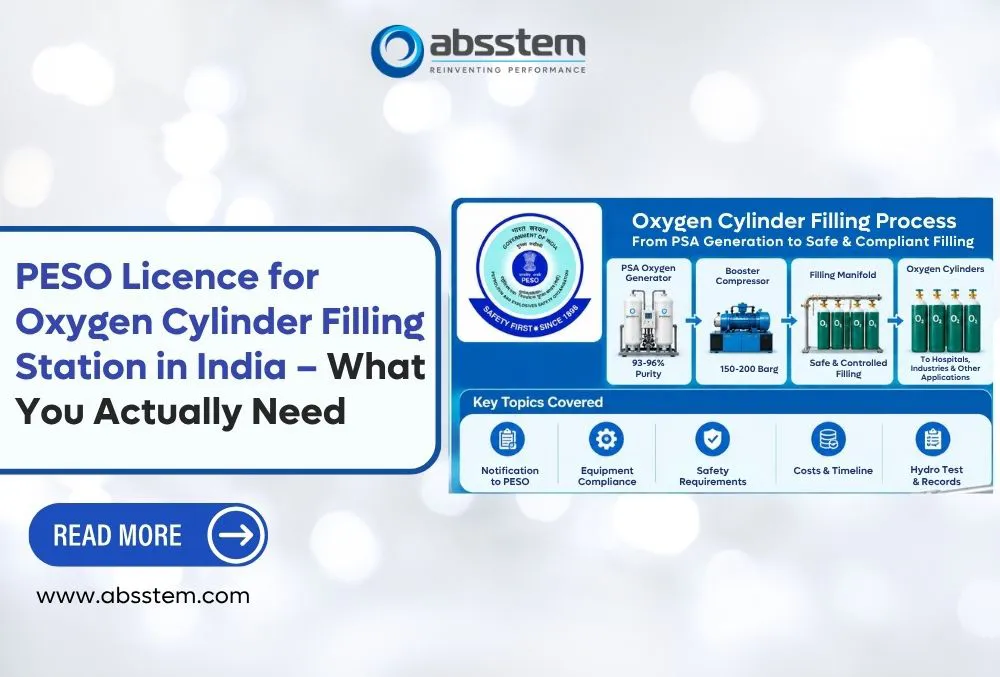
The moment you add a booster compressor and begin filling oxygen cylinders – whether for your own use, for hospitals, or for industrial customers – you fall under the Gas Cylinders Rules 2016 and must notify PESO.
The official guidance is clear:
“If PSA is attached with a compressor and filling of oxygen cylinder is to take place, the hospital must notify it to PESO with the following information: Number of filling points…” (4)
PESO – Who They Are and What They Regulate
PESO – the Petroleum and Explosives Safety Organisation – is the Central Government authority headquartered in Nagpur that regulates explosives, compressed gases, and petroleum products in India under:
- The Explosives Act, 1884
- The Gas Cylinders Rules, 2016 (replacing the older Gas Cylinders Rules, 2004)
- Petroleum Rules, 2002
The Chief Controller of Explosives (CCE), based in Nagpur, is the head of PESO and the authority from whom all cylinder-related permissions, filling permissions, and manufacturer approvals are granted.
PESO has regional offices in:
| Region | Office Location | States Covered |
|---|---|---|
| Head Office | Nagpur, Maharashtra | Maharashtra + national matters |
| North | Faridabad, Haryana | Delhi, UP, Rajasthan, Punjab, Haryana, HP, J&K |
| South | Chennai, Tamil Nadu | Tamil Nadu, AP, Telangana, Karnataka, Kerala |
| East | Kolkata, West Bengal | WB, Odisha, Bihar, Jharkhand, North-East |
| West | Mumbai, Maharashtra | Gujarat, Goa |
What PESO Notification for Oxygen Cylinder Filling Actually Requires
When you notify PESO for a cylinder filling facility (PSA plant with booster compressor), you must provide the following information and comply with these conditions:
Information Required in PESO Notification
| Information Required | Details |
|---|---|
| Number of filling points | How many cylinders are filled simultaneously |
| Type of gas | Oxygen – medical or industrial |
| Source of gas | PSA plant (on-site generation) |
| PSA plant capacity | Nm³/hr rated output |
| Booster compressor details | Make, model, rated pressure (bar) |
| Location and premises | Address, floor plan, clearance dimensions |
| Cylinder details | Type, water capacity (litres), working pressure, IS 7285 compliance |
| Hydrostatic test certification | Valid hydro test certificate for all cylinders in fleet |
Table 2: Required information for PESO Notification
Physical and Safety Conditions – Mandatory
These are not optional good-practice recommendations – they are mandatory compliance conditions under the Gas Cylinders Rules 2016 as specified in PESO’s official guidance (4):
- Safety Relief Valve (SRV) – Mandatory: An SRV (Safety Relief Valve) must be mandatorily installed in the pipeline outlet to the booster compressor. This prevents over-pressurisation of the filling manifold in the event of compressor malfunction.
- Space Clearance – 1 Metre Minimum: The space for filling of cylinders must be isolated and maintain a clearance of 1 metre from the filling point on all sides. No walls, equipment, or obstructions within 1 metre of any filling connection point.
- Ventilation and Illumination: The filling area must be well-ventilated with adequate illumination. Oxygen enrichment of the atmosphere (from leaks) in a poorly ventilated space creates a serious fire hazard.
- Cylinder Pre-Inspection Before Every Fill: Before filling any cylinder, it must be examined and cleaned to confirm the absence of any carbonaceous material, grease, or oil contamination inside. Oil or grease in an oxygen-enriched environment is a serious explosion risk.
- Valid Hydrostatic Test Certificate: Every cylinder being filled must have a valid hydrostatic test certificate confirming the cylinder has been tested at 225 kg/cm² as per IS 7285. Cylinders without a valid, current hydro test certificate must not be filled.
- Competent Supervision: Filling operations must be carried out under the supervision of a competent and experienced person. You cannot leave filling operations to untrained staff.
Hydrostatic Testing of Cylinders – IS 7285 Requirements
Cylinder hydrostatic testing is a mandatory recurring requirement – not a one-time approval. Every oxygen cylinder in your fleet must be periodically hydro-tested and have a valid, current hydro test certificate before it can be legally filled.
Key IS 7285 Requirements
| Requirement | Specification |
|---|---|
| Standard | IS 7285 (Indian Standard for Seamless Steel Gas Cylinders) |
| Test pressure | 1.5× working pressure (hydrostatic), e.g., 225 kg/cm² for standard 150 kg/cm² cylinders, higher for higher working pressure cylinders |
| Periodic re-test interval | Every 5 years or as per cylinder marking |
| Testing authority | PESO-recognised hydrostatic testing station |
| Cylinder markings required | Manufacturer name, serial no., manufacture date, last test date, water capacity, working pressure, gas name |
| Colour coding | Oxygen: Black body with white shoulder (industrial); white shoulder + medical marking for medical grade |
Table 3: Key IS 7285 Requirements (6)
Practical Implication for Your Business
Every cylinder in your fleet needs:
- An IS 7285-compliant initial certification from the manufacturer (7)
- A valid, current hydrostatic test certificate (renewed every 5 years)
- Correct colour coding and permanent markings per the Rules
When buying second-hand cylinders, always verify the hydro test date on the cylinder stamp. Filling an expired cylinder is a violation of the Gas Cylinders Rules 2016 and a serious safety risk.
The PESO Notification Process – Step by Step
PESO’s process for a cylinder filling notification/approval for a PSA-based oxygen filling station is as follows (5 and 8):
Step 1: Prepare your premises and equipment – Complete installation of PSA plant, booster compressor, filling manifold, SRV, and cylinder storage area. Ensure all physical compliance conditions (clearances, ventilation, illumination) are in place before applying.
Step 2: Prepare documentation package – Gather all required documents (see checklist in Section 6 below).
Step 3: Submit notification/application to regional PESO office – Submit to the PESO regional office covering your state. Applications go to the Chief Controller of Explosives via the regional PESO office. Include all documents, the floor plan, and the prescribed fees.
Step 4: PESO inspection – PESO officials will visit your premises to inspect the physical installation, verify compliance with safety conditions (clearances, SRV, ventilation), and review your cylinder fleet and hydro test certificates.
Step 5: Approval/notification acknowledgement – Upon satisfactory inspection, PESO issues acknowledgement of the notification / filling permission. For routine notifications under the Gas Cylinders Rules 2016, this typically takes 4–12 weeks from submission to approval.
Step 6: Periodic compliance – Maintain records of all cylinder fills, hydro test certificates, purity test results, and equipment maintenance. PESO may conduct periodic inspections. Keep your cylinder fleet hydro test certificates current (renew every 5 years per IS 7285).
Complete PESO Compliance Checklist – Oxygen Cylinder Filling Station
Use this checklist before submitting your PESO notification and before commencing filling operations.
A. Documents Required
| Document |
|---|
| Business registration certificate (Pvt Ltd / LLP / Proprietorship) |
| GST registration certificate |
| Factory Licence (if applicable) |
| Land/premises ownership or lease documents |
| Floor plan/layout drawing of filling premises |
| PSA plant technical specifications (make, model, Nm³/hr) |
| Booster compressor specifications (rated pressure, make, model) |
| SRV specifications and installation certificate |
| List of cylinders (serial numbers, water capacity, IS 7285 certificate) |
| Valid hydrostatic test certificates for ALL cylinders in fleet |
| Oxygen analyser calibration certificate |
| Fire NOC from local fire department |
| Pollution clearance from SPCB (if applicable) |
Table 4: Documents Required
B. Physical Compliance – Pre-Inspection Checklist
| Requirement | Specification |
|---|---|
| SRV installed on booster outlet | Mandatory — no exceptions |
| Clearance from filling point | Minimum 1 metre on all sides |
| Ventilation of filling area | Cross-ventilation, no enclosed pockets |
| Illumination | Adequate for safe operation |
| Cylinder storage — segregation | Empty and filled cylinders stored separately |
| Cylinder pre-fill inspection procedure | Documented and in place |
| Competent supervisor identified | Named and designated in writing |
| Fire extinguishers | Appropriate type and capacity for oxygen environment |
| No smoking / no open flame signage | Posted at all filling area entry points |
| Oxygen analyser | Calibrated — records purity of every cylinder filled |
Table 5: Physical Compliance – Pre-Inspection Checklist
C. Cylinder Fleet Compliance
| Requirement |
|---|
| All cylinders IS 7285 compliant |
| Hydro test dates verified — none expired |
| Correct colour coding — oxygen specific |
| Mandatory markings stamped on each cylinder |
| No cylinders with oil/grease contamination |
Table 6: Cylinder Fleet Compliance
PESO Approval Timeline – What to Expect
One of the most common reasons oxygen filling businesses miss their launch dates is underestimating the PESO timeline.
| Stage | Typical Duration |
|---|---|
| Documentation preparation | 2–4 weeks |
| Submission to regional PESO office | Day 1 |
| PESO query resolution (if deficiencies found) | 1–3 weeks additional |
| PESO inspection scheduling | 2–4 weeks after submission |
| Approval/notification acknowledgement | 1–2 weeks post-inspection |
| Total realistic timeline | 6–12 weeks from submission |
Table 7: PESO Approval Timeline – What to Expect
Practical advice: Submit your PESO notification as soon as your premises are ready – do not wait until your entire inventory of cylinders arrives or your customer contracts are signed. The PESO timeline is the critical path item for your launch.
What Happens if You Fill Cylinders Without PESO Notification?
Filling oxygen cylinders without the required PESO notification is a violation of the Gas Cylinders Rules 2016 made under the Explosives Act 1884. Consequences include:
- Seizure of cylinders and filling equipment
- Penalties under the Explosives Act 1884
- Potential criminal liability for the owner/operator
- Liability in the event of a cylinder-related accident or fire
Beyond the regulatory risk, operating without PESO compliance means your customers – hospitals, industrial facilities – cannot verify your cylinders are legally filled, which affects their own compliance and insurance position.
Key Contacts – PESO Regional Offices
| Region | Office Location | States Covered |
|---|---|---|
| Head Office | Nagpur, Maharashtra | Maharashtra, and national |
| North | Faridabad, Haryana | Delhi, UP, Rajasthan, Punjab, Haryana, HP, J&K |
| South | Chennai, Tamil Nadu | Tamil Nadu, AP, Telangana, Karnataka, Kerala |
| East | Kolkata, West Bengal | WB, Odisha, Bihar, Jharkhand, North-East |
| West | Mumbai, Maharashtra | Gujarat, Goa |
Table 8: PESO Regional Offices (5)
Internal Resources – Next Steps
If you have completed your PESO research and are now ready to evaluate PSA oxygen plant options for your filling station:
- Idos – PSA Industrial Oxygen Generator – For industrial oxygen filling stations above 100 Nm³/hr
- Idos C – Affordable PSA Industrial Oxygen Generator for SMEs – For smaller filling stations up to 100 Nm³/hr, plug-and-play
- MedO – PSA Medical Oxygen Generator – For medical oxygen cylinder filling requiring ISO 13485 manufacturing quality
- Free ROI Calculator – Estimate your payback period
Consult Us
For high-purity oxygen generation systems contact us:
- Email: info@absstem.com
- Phone: 1800 547 0506
- Website: absstem.com
References
-
-
- Absstem Technologies. (2026) How to Start an Oxygen Cylinder Refilling Business in India (2026 Complete Guide)
- Absstem Technologies. (2026) Medical Oxygen Refilling vs Industrial Oxygen Refilling – Key Differences India (2026)
- Lexcomply Archive / PIB (2021). PESO clarification: PSA plants with no filling = no PESO licence required.
- PIB – Press Information Bureau, Government of India (2021). Relaxations under Gas Cylinders Rules 2016 to fast-track approvals for medical oxygen. PESO guidelines for PSA installations with cylinder filling facility.
- PESO – Petroleum and Explosives Safety Organisation (2016). Gas Cylinders Rules.
- PESO Consultant. Gas Cylinder Rules Approval – IS 7285 hydrostatic test requirements, marking specifications, and PESO process.
- Seyecs (2026). PESO Licence for Oxygen Cylinder Manufacturers – IS 7285 compliance, mandatory markings, approval process.
- Diligence Certification (2026). PESO Approval for Hydro Testing Station – process, documentation, and inspection requirements.
- USAID RISE / PATH (2022). SOP on PESO Certification for Health Facilities – oxygen cylinders, cryogenic tanks, PSA plants.
- Tanky (2025). Hydrostatic Testing of Oxygen Cylinders.
- Diligence Certification (2025). IS 7285 Part 2.
-