Introduction
India’s oxygen industry is growing at a pace few expected even five years ago. The 2021 COVID-19 crisis exposed a structural vulnerability in the country’s oxygen supply chain – and it triggered a wave of investment in on-site oxygen generation and cylinder distribution infrastructure that continues today.
The result: starting an oxygen cylinder refilling business in India in 2026 is a significantly more viable proposition than it was even in 2022, with clearer regulatory frameworks, more competition among equipment suppliers, and – critically – a customer base that now understands the value of a reliable local oxygen source.
This guide covers everything you need to know: market opportunity, business models, equipment, licences, real cost data, and how to calculate your ROI before you spend a rupee.
Market Opportunity – Why 2026 is a Good Time to Enter
India’s industrial gas market is expanding steadily across both medical and industrial applications. Key demand drivers in 2026:
Medical oxygen demand is structurally higher than pre-2021 levels. The PM CARES Fund installed over 1,500 PSA oxygen plants at government hospitals between 2021 and 2023, creating a new baseline of awareness and acceptance of on-site oxygen generation. Tier-2 and Tier-3 cities – where cylinder logistics are most expensive and unreliable – represent the highest-growth segment for local refilling businesses.
Industrial oxygen demand is driven by India’s manufacturing expansion: steel and metal processing (EAF furnace enrichment), aquaculture (dissolved oxygen for fish farming), wastewater treatment (aerobic biological treatment), and ozone generation for water disinfection. The Atmanirbhar Bharat and Make in India initiatives are accelerating industrial growth, directly increasing oxygen consumption.
The cylinder distribution model remains essential. Even where large facilities install on-site PSA plants for their own use, smaller customers – clinics, small workshops, aquaculture farms, welding contractors – depend on cylinder supply from local distributors. This is your core market as a refilling business.
Source: IndexBox (2026). India Oxygen Cylinders Market Analysis, Forecast, Size, Trends and Insights. https://www.indexbox.io/store/india-oxygen-cylinders-market-analysis-forecast-size-trends-and-insights/
Three Business Models – Choose Before You Invest
Before looking at equipment or licences, decide which business model you are entering. They have different capital requirements, regulatory paths, and customer bases.
Model A: Industrial Oxygen Cylinder Refilling
What you do: Generate oxygen on-site using a PSA plant + booster compressor, fill industrial oxygen cylinders, and sell or distribute to industrial customers.
Your customers: Welding and fabrication shops, steel fabricators, aquaculture farms, glass manufacturers, waste treatment plants, foundries.
Purity required: 90–96% (industrial grade – no pharmacopoeia compliance needed).
PESO requirement: PESO is required if you are filling cylinders for sale or distribution. PSA plant alone (without cylinder filling) – no PESO approval needed.
Capital range: ₹50 lakh – ₹1.5 crore depending on capacity.
Model B: Medical Oxygen Cylinder Refilling
What you do: Generate medical-grade oxygen (93–96%, IP/WHO/USP compliant) using an ISO 13485-aligned PSA plant + booster, fill medical oxygen cylinders, and supply to hospitals, clinics, and nursing homes.
Your customers: Hospitals, nursing homes, community health centres, home healthcare providers.
Purity required: 93–96% (Indian Pharmacopoeia, WHO, USP, BP compliant).
PESO requirement: PESO is mandatory for cylinder filling. Additional documentation for medical-grade supply.
Capital range: ₹50 lakh – ₹4 crore (higher due to medical-grade equipment and compliance requirements).
Model C: Captive On-Site Generation (Not a Refilling Business)
What you do: Install a PSA oxygen plant for your own use – hospital, factory, aquaculture farm – without selling oxygen to others.
PESO requirement: None for the PSA generator itself. PESO Licence is only required if you add a booster and fill cylinders.
Note: This model is covered in detail on our Idos PSA Industrial Oxygen Generator and MedO PSA Medical Oxygen Generator product pages.
Who Typically Starts an Oxygen Refilling Business?
Based on the typical customer profile across India:
- Existing gas distributors expanding from cylinder trading into on-site generation to reduce their own purchase cost and improve margins
- Industrial entrepreneurs in manufacturing clusters (steel, fabrication, auto ancillary) who see local oxygen demand from their peer businesses
- Hospital groups and nursing home chains adding cylinder refilling capacity to nearby satellite facilities
- Aquaculture entrepreneurs in coastal states (Andhra Pradesh, Tamil Nadu, Odisha, West Bengal) where oxygen demand for shrimp and fish farming is growing rapidly
- Rural healthcare entrepreneurs in districts where cylinder logistics are expensive and unreliable
Before You Start – Site and Infrastructure Requirements
Location
Choose a location that is:
- Accessible by road for cylinder delivery and pickup vehicles (minimum 3-tonne truck access)
- Not within a residential zone (check local zoning and factory licence requirements)
- Close to your primary customer base to minimise cylinder transport cost
- Connected to reliable 3-phase power supply
Space Requirements
| Component | Minimum Area |
|---|---|
| PSA oxygen generator | 20–50 m² (depends on capacity) |
| Booster compressor | 10–15 m² |
| Cylinder storage (empty + filled) | 30–100 m² |
| Buffer/storage tank | 10–20 m² |
| Office and utility area | 10–15 m² |
| Total minimum | 80–200 m² |
Source: Absstem Technologies. What is Medical Oxygen Plant Setup Cost in India. https://absstem.com/what-is-medical-oxygen-plant-setup-cost-in-india/
Power Requirements
A PSA oxygen plant is an electricity-intensive system. As a reference:
- A 10 Nm³/hr PSA plant (fills approximately 25 cylinders/day) consumes approximately 14 kW continuously
- A 50 Nm³/hr system consumes approximately 70 kW continuously
- Plan for 3-phase power with adequate sanctioned load – your electricity connection approval should cover peak draw, including compressors and booster
Backup power planning is critical for a refilling business. If power goes down mid-fill cycle, system downtime costs you cylinder capacity and customer relationships.
Source: Indian Journal of Anaesthesia / PubMed (2024). Cost analysis of different medical oxygen sources for a healthcare facility in India. https://pubmed.ncbi.nlm.nih.gov/38586273/
Water Requirements
Most PSA systems are air-cooled and do not require a continuous water supply. However, if your compressor is water-cooled, plan for a treated water supply and a cooling tower. Confirm with your equipment supplier at the design stage.
Licences and Approvals
This is the section most first-time entrepreneurs get wrong. The regulatory path depends on exactly what you are doing – generating oxygen only, or generating and filling cylinders.
The Critical PESO Distinction
PSA plant for direct supply (piped) → No PESO licence required If your PSA plant produces oxygen that is piped directly to the point of use (hospital MGPS, factory piping), it is exempt from PESO Gas Cylinders Rules 2016 licensing.
PSA plant + booster compressor + cylinder filling → PESO Licence required. The moment you add a booster compressor and fill cylinders for sale or distribution, PESO rules apply. You must notify the Chief Controller of Explosives (PESO) and comply with Gas Cylinders Rules 2016 requirements, including:
- Minimum 1 metre clearance from filling point to walls/obstructions
- Safety Relief Valve (SRV) mandatory on the filling manifold
- Cylinder hydrostatic testing compliance (cylinders must be tested at 225 kg/cm² per IS 7285)
- Records of all cylinder fills and testing
Source: PIB – Press Information Bureau, Government of India. FAQs on Medical Oxygen – PESO Regulations for PSA Plants. https://pib.gov.in/PressReleasePage.aspx?PRID=1711399
Complete Licence and Approval Table
| Requirement | Mandatory? | Authority | Notes |
|---|---|---|---|
| Business Registration (Pvt Ltd / LLP / Proprietorship) |
Yes | MCA / State Registrar | Do this first |
| GST Registration | Yes | GST Department | Required for B2B supply |
| Factory Licence | If employing workers in manufacturing | State Labour / Factory Inspector | Threshold varies by state |
| Pollution Clearance (NOC) |
If applicable | State Pollution Control Board (SPCB) | Required in most states for industrial operations |
| PESO Licence | Required if filling cylinders | Chief Controller of Explosives, PESO, Nagpur | PSA direct supply without filling = EXEMPT |
| Fire NOC | Usually required | Local Fire Department / Municipality | Mandatory for cylinder storage areas |
| Trade Licence | Yes | Local Municipal Body | Varies by city/town |
| Electricity Connection (3-phase) |
Yes | State DISCOM | Apply early – can take 4–8 weeks |
Source: PESO – Petroleum and Explosives Safety Organisation. Gas Cylinders Rules 2016. https://peso.gov.in/
Equipment Required – Complete List
A complete PSA-based oxygen cylinder refilling station comprises the following components:
| Equipment | Purpose | Notes |
|---|---|---|
| Air Compressor | Compresses atmospheric air as feed for PSA process | Oil-free type recommended for medical applications |
| Air Dryer (Refrigerated) | Removes moisture from compressed air | Critical – moisture damages zeolite sieves |
| Air Filters (multi-stage) | Removes oil, dust, and particulates | Pre-filter + coalescing filter + activated carbon |
| PSA Oxygen Generator | Separates oxygen from air using zeolite molecular sieves | Core unit – produces 90–96% oxygen |
| Oxygen Buffer Tank | Stores generated oxygen before filling | Sized for continuous filling without pressure drop |
| Booster Compressor | Elevates oxygen pressure to cylinder filling pressure (150+ bar) | Required for cylinder filling – not needed for direct piped supply |
| Cylinder Filling Ramp / Manifold | Connects booster output to multiple cylinders simultaneously | Fills 4–12 cylinders at a time depending on ramp size |
| Oxygen Cylinders (own fleet) | For distribution to customers | Standard 7 m³ (46.7 L water capacity) industrial; jumbo cylinders for medical |
| Oxygen Analyser | Continuously monitors and verifies oxygen purity | Mandatory for medical grade; strongly recommended for industrial |
| PLC Control Panel | Automates system operation | Reduces manpower requirement |
Process Flow – How It Works
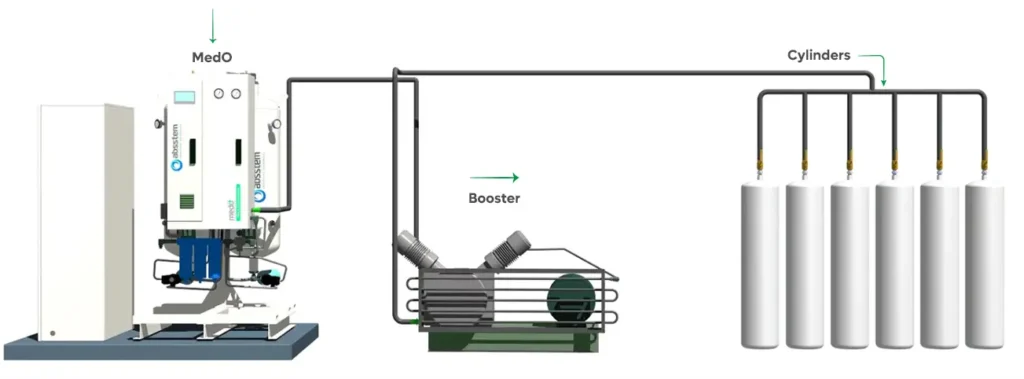
The entire process from atmospheric air to filled cylinder is continuous and automated once the system is running – minimal manual intervention required beyond cylinder connection and disconnection.
How Big Should Your PSA Plant Be? – Sizing Guide
The size of your PSA oxygen generator determines how many cylinders you can fill per day. Use this as your primary sizing reference:
Standard Oxygen Cylinder Reference (India)
A standard industrial oxygen cylinder (Type B, 46.7 L water capacity) holds approximately 7 Nm³ of oxygen at 150 bar.
A jumbo medical oxygen cylinder holds approximately 10 Nm³ at 150 bar.
Cylinders Per Day vs PSA Plant Capacity
| Cylinders/Day (7 Nm³ type) | Oxygen Required (Nm³/day) | PSA Plant Size | Typical System Cost |
|---|---|---|---|
| 20–25 cylinders/day | ~140–175 Nm³/day | 7–10 Nm³/hr PSA | ₹40–50 lakh |
| 50–75 cylinders/day | ~350–525 Nm³/day | 20–25 Nm³/hr PSA | ₹50–60 lakh |
| 100–150 cylinders/day | ~700–1,050 Nm³/day | 40–50 Nm³/hr PSA | ₹60–90 lakh |
| 200+ cylinders/day | 1,400+ Nm³/day | Multiple PSA systems | ₹1.2 crore+ |
Source: Absstem Technologies. What is Medical Oxygen Plant Setup Cost in India – ₹15 lakh to ₹4 crore range. https://absstem.com/what-is-medical-oxygen-plant-setup-cost-in-india/
Monthly Operating Expenses (OPEX)
| Expense | Small (25 cyl/day) | Medium (75 cyl/day) | Large (150+ cyl/day) |
|---|---|---|---|
| Electricity (₹8/kWh avg.) | ₹20,000–25,000 | ₹125000-150000 | ₹270,000-350,000 |
| Labour (1–2 operators) | ₹20,000–40,000 | ₹40,000–70,000 | ₹70,000–120,000 |
| Filter replacement | ₹3,000–5,000 | ₹6,000–10,000 | ₹10,000–18,000 |
| Compressor servicing (amortised) | ₹5,000–8,000 | ₹10,000–15,000 | ₹15,000–25,000 |
| Cylinder testing/maintenance | ₹3,000–5,000 | ₹6,000–10,000 | ₹10,000–15,000 |
| Miscellaneous | ₹5,000 | ₹8,000–12,000 | ₹15,000–20,000 |
| Total Monthly OPEX | ₹56,000–83,000 | ₹195,000–267,000 | ₹490,000–548,000 |
ROI Calculator – PSA vs Buying Oxygen
This is the core financial question: Is it more economical to generate oxygen on-site and fill your own cylinders, or to buy oxygen from an external supplier and resell?
Cost per Cylinder – PSA Generation vs External Purchase
The Indian Journal of Anaesthesia published a peer-reviewed cost analysis (2024) that provides verified ₹/cylinder cost data across supply methods:
| Oxygen Source | Cost per Jumbo Cylinder (₹) |
|---|---|
| PSA plant (500 LPM, 24h on electricity) | ₹110.93 |
| Liquid Medical Oxygen (LMO) refilling | ₹288.17 |
| Third-party vendor cylinder refilling | ₹348.34 |
| On-site PSA refilling with booster (500 LPM) | ₹185.21 |
The conclusion from peer-reviewed research: PSA generation with on-site refilling is significantly more cost-effective than any form of purchased oxygen for facilities running at reasonable capacity on electricity.
Source: Indian Journal of Anaesthesia / PubMed (2024). Cost analysis of different medical oxygen sources for a healthcare facility in India. DOI: 10.4103/ija.ija_335_23. https://pmc.ncbi.nlm.nih.gov/articles/PMC10993950/
Indicative ROI for a Cylinder Refilling Business (Medium Scale – 75 cyl/day)
| Particular | Monthly |
|---|---|
| Revenue (75 cylinders/day × 25 days × ₹500 fill charge) | ₹9.37 lakh |
| Operating cost (electricity + labour + maintenance) | |
| Gross margin | ₹7.4–7.9 lakh/month |
| CAPEX (₹70 lakh midpoint) | |
| Estimated payback | 9–12 months |
Note: Revenue per cylinder varies significantly by market (industrial vs medical, urban vs rural, competition). ₹500/cylinder fill charge is illustrative for industrial oxygen in a Tier-2 city. Medical oxygen commands higher fill charges. Actual payback depends on utilisation, local pricing, and cylinder ownership model.
Common Mistakes – What First-Time Operators Get Wrong
Mistake 1: Undersizing the Compressor
The air compressor is the foundation of the entire system – it provides the compressed air feed for the PSA process. Undersizing the compressor means the PSA generator never reaches its rated output, and you cap your cylinder fill capacity well below what you paid for. Always size the compressor to 120% of the PSA generator’s rated air consumption.
Mistake 2: Skipping Air Treatment (Dryer + Filters)
Moisture and oil in the compressed air feed will destroy zeolite molecular sieves – the most expensive consumable in a PSA system. A refrigerated air dryer and multi-stage filtration system are not optional add-ons; they are essential for system longevity. Do not cut costs here.
Mistake 3: Ignoring Future Expansion
A PSA plant that fills 25 cylinders/day today may need to fill 75 cylinders/day in 18 months if your business grows. Installing a slightly larger compressor and buffer tank at the outset costs marginally more than the base system – but retrofitting later costs 2–3x more than getting it right initially. Build in 30–40% headroom.
Mistake 4: Choosing the Wrong Purity Setting
Industrial oxygen applications (welding, cutting, aquaculture) work well at 90–95% purity. Medical oxygen requires 93–96% (IP/WHO/USP compliant). If you intend to supply both markets, configure your plant at 93–96% from the start and maintain the oxygen analyser calibration. Never supply industrial-grade oxygen to hospitals or medical end-users – this is a safety and legal compliance issue.
Mistake 5: No Backup Power Plan
A cylinder refilling business that stops filling every time the power goes out loses customer confidence rapidly. Evaluate whether a backup generator is warranted for your scale. For medical oxygen supply, backup power is non-negotiable.
Mistake 6: Underestimating PESO Timeline
PESO notification and approval for cylinder filling can take 4–12 weeks depending on the regional office workload. Factor this into your launch timeline – do not complete installation and then discover you cannot start filling until PESO clearance arrives.
Internal Resources and Next Steps
If you are evaluating a PSA oxygen plant for your refilling business, Absstem’s Idos series covers the full range of industrial oxygen generation:
- Idos – PSA Industrial Oxygen Generator – for larger refilling stations above 100 Nm³/hr
- Idos C – Affordable PSA Industrial Oxygen Generator for SMEs – for smaller setups up to 100 Nm³/hr, plug-and-play format
- Free ROI Calculator – calculate your specific payback period
For medical oxygen cylinder refilling specifically:
- MedO – PSA Medical Oxygen Generator – ISO 13485-certified medical oxygen generation
Consult Us
For high-purity oxygen generation systems contact us:
- Email: info@absstem.com
- Phone: 1800 547 0506
- Website: absstem.com
References
- IndexBox (2026). India Oxygen Cylinders Market Analysis, Forecast, Size, Trends and Insights. https://www.indexbox.io/store/india-oxygen-cylinders-market-analysis-forecast-size-trends-and-insights/
- Indian Journal of Anaesthesia / PubMed (2024). Cost analysis of different medical oxygen sources for a healthcare facility in India. Indian J Anaesth. 2024;68(4):374–379. DOI: 10.4103/ija.ija_335_23. https://pubmed.ncbi.nlm.nih.gov/38586273/
- PMC / NIH (2024). Table 2: Equivalent jumbo cylinder costs from various sources of oxygen (PSA vs LMO vs third-party). https://pmc.ncbi.nlm.nih.gov/articles/PMC10993950/
- PESO – Petroleum and Explosives Safety Organisation. Gas Cylinders Rules 2016. https://peso.gov.in/
- PIB – Press Information Bureau, Government of India. FAQs on Medical Oxygen – PESO Regulations for PSA Plants. https://pib.gov.in/PressReleasePage.aspx?PRID=1711399
- Absstem Technologies. What is Medical Oxygen Plant Setup Cost in India. https://absstem.com/what-is-medical-oxygen-plant-setup-cost-in-india/
- Absstem Technologies (2024). Comparison of the Cost of Oxygen Gas from Different Sources. https://absstem.com/oxygen-cylinder-cost-vs-psa-plant/