

Nitrogen is one of the most common inert industrial gases used across diverse applications such as food preservation, electronics manufacturing, metal processing, and many more. Traditionally, nitrogen supply depended on high-pressure cylinders or bulk liquid nitrogen deliveries, both costly and logistically challenging.
A PSA Nitrogen Generator, also known as a PSA Nitrogen Plant, offers an efficient and sustainable alternative, producing nitrogen onsite from atmospheric air using Pressure Swing Adsorption (PSA) technology.
What is a PSA Nitrogen Generator?
A PSA Nitrogen Generator is a system that separates nitrogen gas from atmospheric air using Pressure Swing Adsorption technology. By utilising the different adsorption properties of nitrogen and oxygen, the system captures oxygen molecules while allowing nitrogen to pass through, producing high-purity nitrogen gas for direct industrial use.
Working Principle of PSA Nitrogen Generators
PSA nitrogen plants work on adsorption, a surface phenomenon where certain gas molecules adhere to the surface of an adsorbent.
Key process steps
- Air Compression: Atmospheric air is compressed to 6-7 barg.
- Moisture Removal: A refrigerated air dryer cools the air, removing moisture.
- Impurity Filtration: Air passes through filters to remove dust, oil, and contaminants.
- Adsorption Process: In the PSA Tower, beds filled with carbon molecular sieves and activated alumina, oxygen molecules are adsorbed while nitrogen passes through.
- Storage & Supply: Produced nitrogen is stored in a nitrogen tank for continuous usage.
The process is fully automated with PLC-controlled valves for continuous nitrogen supply.
Components of a PSA Nitrogen Generation System
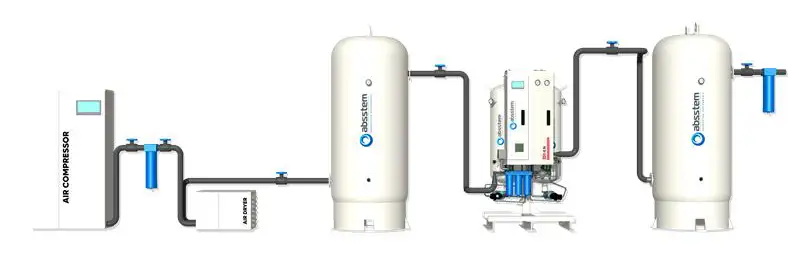
A PSA Nitrogen Plant consists of multiple interconnected systems, each playing a critical role in nitrogen production. The key components are:
- Air Compressor
PSA Nitrogen generators operate on pressure variations within the PSA bed. An air compressor increases the pressure of atmospheric air to typically 6-7 barg. Modern installations use screw compressors for their high efficiency, low noise, and compact footprint. - Air Dryer
A refrigerated air dryer removes moisture from compressed air. The air is cooled via a refrigerant gas, and the condensed moisture is separated and drained. This step is essential to prevent water vapour from getting in contact with the CMS (Carbon molecular sieves). - Air Receiver / Air Tank
Air demand in the PSA bed fluctuates during operation. An air receiver smooths out these variations, ensuring a steady pressure supply and allowing the compressor to run more efficiently. - Air Line Filters
When lubricated screw compressors are used, the compressed air can contain oil vapours and fine dust particles. A series of airline filters removes these contaminants, as oil and moisture are harmful to Carbon Molecular Sieves (CMS) used in nitrogen separation. - PSA Nitrogen Generator
The PSA Nitrogen Generator consists of PSA Towers (pressure vessel) packed with carbon molecular sieves and activated alumina. Compressed air enters the PSA tower, and oxygen molecules are adsorbed onto the sieve surface while nitrogen passes through. This process is fully automated, controlled by valves and a PLC (Programmable Logic Controller), ensuring consistent nitrogen purity. - Nitrogen Storage Tank
Nitrogen production in a PSA plant is cyclic rather than continuous, but most industrial processes require a steady flow. A nitrogen tank acts as a buffer, storing gas during production cycles and supplying it seamlessly to the application.
- Air Compressor
Industrial Applications of PSA Nitrogen Generators
PSA nitrogen plants serve multiple industries:
- Food & Beverage: Modified Atmosphere Packaging (MAP)
- Metallurgy: Purging (Furnaces), heat treatment, laser cutting
- Oil & Gas: Tank blanketing, pipeline purging
- Manufacturing: 3D printing, tyre production, cable manufacturing
- Electronics: Semiconductor manufacturing using SMT (Surface Mount Technology)
- Testing: Pressure testing, leak testing
- Recycling: Inert atmosphere creation for tire pyrolysis
- Automotive: Tire inflation, welding purge gas
Nitrogen Supply Sources & Comparison
Apart from PSA Nitrogen generators, Nitrogen is supplied in industry via Nitrogen cylinders and liquid Nitrogen tanks.
Comparison between different sources of Nitrogen gas
| Parameter | Liquid Nitrogen | High-Pressure Cylinders | PSA Nitrogen Generator |
| Cost per Nm³ | High (₹13-₹25) | Very High (₹70-₹150) | Low (₹1.7-₹10.5) |
| Risk Level | High (cryogenic expansion) | Very High (150 barg pressure) | Low (6.5 barg) |
| Third-Party Dependence | Yes | Yes | No |
| Carbon Emissions | High | High | Very Low |
We’ve written about this in our blog titled, Comparison of the Cost of Nitrogen Gas from Different Sources . Please read to know more.
Cost of Nitrogen from Different Sources
| Source | Cost per Nm³ (₹) |
| Liquid Nitrogen | ₹13 – ₹25 |
| High-Pressure Cylinders | ₹70 – ₹150 |
| PSA Nitrogen Generator | ₹1.7 – ₹10.5 (depends on purity) |
For detailed purity-cost correlation, read our blogs titled, Understanding Nitrogen Purity in PSA Nitrogen Generators and Nitrogen Pressure Required for Different Industrial Applications .
ROI of PSA Nitrogen Generators
PSA nitrogen generators not only reduce operational costs but also eliminate logistics and delivery delays. With savings of up to 90% compared to cylinders, ROI is typically achieved within 6-18 months, making them one of the fastest payback investments in industrial gas systems.
Consult Us
For tailored solutions and expert advice on PSA Nitrogen, contact us:
- Email: info@absstem.com
- Phone: 1800 547 0506
- Website: absstem.com
References
- Absstem Technologies. (2024). Comparison of the Cost of Nitrogen Gas from Different Sources
- Absstem Technologies. (2024). Understanding Nitrogen Purity in PSA Nitrogen Generators
- Absstem Technologies. (2024). Nitrogen Pressure Required for Different Industrial Applications